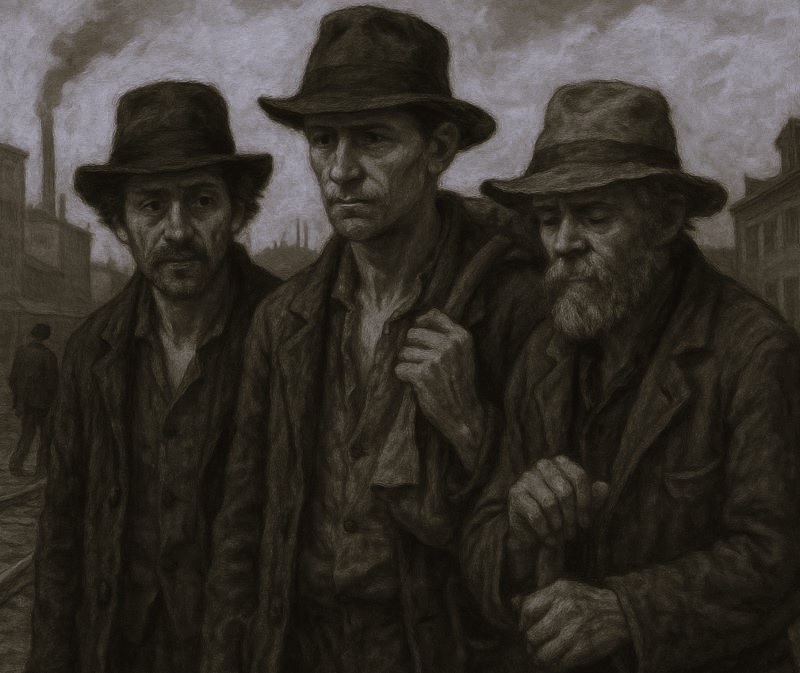
The Dying Art of Being a Bum

Welcome to the Precious Metals Bug Forums

Welcome to the PMBug forums - a watering hole for folks interested in gold, silver, precious metals, sound money, investing, market and economic news, central bank monetary policies, politics and more.

Why not register an account and join the discussions? When you register an account and log in, you may enjoy additional benefits including no Google ads, market data/charts, access to trade/barter with the community and much more. Registering an account is free - you have nothing to lose!

searcher

morning
Moderator
Benefactor
Messages
33,675
Reaction score
5,711
Points
288

The Dying Art of Being a Bum​

There’s a type of laughter so delirious and so extreme it seems to be the audiological equivalent of a witch’s spell. It’s a man’s laughter — a lazy man’s laughter — a bold and hearty chuckle of such pentameter that it seems almost to be electro-mechanically generated and whiskey-fueled; a kind of neverending cackling sound of such a rhythm that those who hear it are only stunned, beside themselves, or caught in a kind of startled paralysis until the madman’s storm of chuckling finally subsides.

And this time, such chuckling came with a bold, hoarse-voiced declaration from a leather-cheeked fellow who bellowed madly in the silence of the early morning gas station:

More:


Where the hobo sought labor, the tramp was a non-worker by inclination, at least in popular lore and within the transient community itself. Tramps also traveled widely—often using the same railroads and routes as hobos—but were less willing or less able to work consistently. Some took the occasional job, especially when hungry or desperate, but their identity was tied less to labor and more to the act of wandering itself.

Contemporary accounts and reform literature often portrayed tramps as morally suspect: lazy, shiftless, even dangerous.3 Yet many tramps rejected the exploitative conditions of low-wage labor and adopted their lifestyle as a protest against industrial capitalism. Some tramps, especially in the 1870s and 1880s, were veterans of the Civil War or victims of economic collapse. Others suffered from alcoholism, mental illness, or social alienation. Their resistance to work could be read either as failure or as refusal, depending on one’s political lens.4

To hobos, however, the distinction was clear: a tramp was a loafer, someone who traveled but did not earn. This internal class division among the wandering poor reflected deeper tensions in American attitudes toward poverty—between those who could be redeemed through work and those who were seen as permanently deviant.

***

At the bottom of the hierarchy stood the bum—a figure often portrayed as stationary, degenerate, and wholly removed from the world of work. Unlike hobos or tramps, bums were urban dwellers who begged or scavenged and made no pretense of seeking employment. They were fixtures of city slums and back alleys, often associated with drunkenness and disease.

In the eyes of both society and their more mobile counterparts, bums represented failed manhood, the loss of initiative and independence.5 Hobos who lost the strength to work or the will to travel feared “bumming out”—becoming what they considered the most degraded form of the wanderer. This fear was deeply gendered; as American notions of masculinity were tied closely to labor and autonomy, the bum represented the erosion of both.

The term “bum” was thus the most derogatory, used to shame or dismiss those seen as beyond help or beneath respect. Reformers and journalists often conflated bums with all homeless men, contributing to moral panic and calls for stricter vagrancy laws.
 
Back
Top Bottom