
You are using an out of date browser. It may not display this or other websites correctly.
You should upgrade or use an alternative browser.
You should upgrade or use an alternative browser.
2026 Lunatic Fringe - Market and Trade Chat
- Thread starter pmbug
- Start date
Welcome to the Precious Metals Bug Forums
Welcome to the PMBug forums - a community supported watering hole for folks interested in gold, silver, precious metals, sound money, investing, market and economic news, central bank monetary policies, politics and more.
Register a free account to join the discussions. When you register an account and log in, you may enjoy additional benefits including access to market data/charts and additional members only rooms (including one for trade/barter with the community).


- Messages
- 22,670
- Reaction score
- 12,723
- Points
- 288
the Canary in the coal mine? Clive Thompson
Lending drying up.
Small and medium size companies can't get financing. Profits fall.
Economy slows.
Business reducing.
Number of people employed falling.
Unemployment rising - The Fed can't hike rates
Core PCE inflation at 3% - The Fed can't cut.
Oil prices up 50% in 3 months. Could drive up prices.
Oil could go through $100.
Treasury yields rising. Bond prices falling.
Stocks falling.
60:40 portfolios not working.
Real interest rates falling and could go negative.
Stagflation now a real possibility.
Can't buy bonds.
Can't buy stocks.
Negative real rates would be explosive for gold.
Time to buy gold and silver.
The dominos are falling. The cockroaches have arrived. Gold and silver are the only refuge.
Private Credit: Blowing up. You can't have your money back.Lending drying up.
Small and medium size companies can't get financing. Profits fall.
Economy slows.
Business reducing.
Number of people employed falling.
Unemployment rising - The Fed can't hike rates
Core PCE inflation at 3% - The Fed can't cut.
Oil prices up 50% in 3 months. Could drive up prices.
Oil could go through $100.
Treasury yields rising. Bond prices falling.
Stocks falling.
60:40 portfolios not working.
Real interest rates falling and could go negative.
Stagflation now a real possibility.
Can't buy bonds.
Can't buy stocks.
Negative real rates would be explosive for gold.
Time to buy gold and silver.

- Messages
- 858
- Reaction score
- 711
- Points
- 268
Those call options are probably very cheap. Maybe it is someone just "playing the lottery" for fun and amusement.
Maybe it is a player that is throwing this into the news cycle to nudge the market a few points.
"And maybe the horse will learn to sing..." (reference from "The Mote in God's eye.")
Maybe it is a player that is throwing this into the news cycle to nudge the market a few points.
"And maybe the horse will learn to sing..." (reference from "The Mote in God's eye.")


FWIW:
...
At its core, this is a bull call debit spread: buy the $15,000 call (the long leg for leveraged upside exposure) and sell the $20,000 call (the short leg to offset premium costs and cap maximum gains at $5,000 per ounce intrinsic value).
Each contract controls 100 ounces, so roughly 11,000 contracts deliver notional exposure to about 1.1 million ounces—equivalent to roughly $16.5 billion at the $15,000 strike, or around $5.5–$5.6 billion at the prevailing spot price near $5,100 as of February 20 (per CME and market data).
But the real outlay? Far less. With premiums estimated around $18.00 per ounce for the $15,000 call and $7.00 per ounce for the $20,000 call (based on recent CME levels and implied volatility), the net debit per spread falls in the range of $1,100–$1,800 per contract (depending on exact fills, bid-ask spreads, and implied volatility fluctuations). For the full position, total risk capital amounts to roughly $12–$20 million at maximum loss—if gold remains flat or below $15,000 at December expiration.
That’s modest sizing for a serious macro fund or high-conviction player, yet it delivers extraordinary convexity: a explosive move above $15,000 could generate 10x–50x returns on the risked capital, turning this into a true “lottery ticket” with defined downside and uncapped (within the spread) upside potential in a regime-shift scenario.
...

Is that the last strike price? Because we've seen this for a long time now in Gamestop. For some reason the highest strike calls always had a ton of volume... BUT its not necessarily bulls. I think its some type of synthetic trade and they are trying to protect themselves cheaply from a squeeze.
Ok, after seeing the data in the post above, Thanks Bug. But that is not the same. Clearly it is likely a spread trade and certainly would be bullish. Its a low cost / "low" likely trade with big upside.
Last edited:
Short term headwind for oil incoming:

- Messages
- 22,670
- Reaction score
- 12,723
- Points
- 288
"Biggest Bubble In History Is About To Burst..." - Dave Collum
Dave Collum is a Professor of Chemistry at Cornell University. In this video he discuss asset prices in 2025, the economy, and the impact of monetary policy on markets. Dave explains why he believes the stock market is overvalued, why he’s concerned about risk assets, and why he’s uneasy about gold’s strong performance despite being a major holder.
I've interacted with Dave on X. He's been very unsure about gold and silver for a while. He doesn't really understand the physical demand story. He did give me a follow a while back though. Maybe he's reading my posts these days. 
- Messages
- 22,670
- Reaction score
- 12,723
- Points
- 288
Why Silver Could Be the Most Mispriced Asset on Earth
Michelle Makori, President & Editor-in-Chief of Miles Franklin Media, breaks down why silver may be the most undervalued asset in the world right now – despite surging demand across energy, technology, defense, and finance.Silver is essential to modern civilization. It powers solar panels, electric vehicles, semiconductors, AI infrastructure, medical technology, aerospace systems, and advanced military equipment. Yet even after a major rally, silver still trades far below its inflation-adjusted highs and may be dramatically mispriced relative to its strategic importance.
At the same time, global inventories are shrinking, industrial demand is accelerating, and physical silver is migrating from Western vaults to Eastern manufacturing economies. Meanwhile, the paper derivatives market continues to dominate price discovery, creating a widening gap between physical supply and financial claims.
Is silver becoming one of the most strategically important metals in the world?
In this special Real Story episode, Michelle Makori examines the powerful forces converging in the silver market and why some analysts believe the metal could be dramatically undervalued.
In this episode of The Real Story with Michelle Makori:
- The global silver supply crunch
- Industrial demand from AI, EVs, and solar
- Why silver is critical to national security
- COMEX and LBMA inventory declines
- Paper silver vs physical silver markets
- Silver’s role as a monetary metal
- The inflation-adjusted price of silver
- Why some believe silver is historically undervalued
- Messages
- 22,670
- Reaction score
- 12,723
- Points
- 288
I'm not up to speed on the industrial use of this carbon fiber, but it sounds like China made a significant breakthrough on manufacturing it:
I've used carbon fiber with epoxy. Not as thin as this is, but thin like fine hair thin.
Amazing stuff!
I asked GROK how carbon fiber is made:
Carbon fiber is an incredibly strong, lightweight material made almost entirely of carbon atoms arranged in a crystalline structure. It's produced through a multi-step industrial process that starts with an organic precursor material and transforms it via heat and chemical treatments. Over 90% of commercial carbon fiber today is made from polyacrylonitrile (PAN) precursor (a synthetic polymer). Smaller amounts come from pitch or (rarely now) rayon/cellulose-based precursors.Here are the main steps in the standard PAN-based carbon fiber manufacturing process:
- Polymerization / Precursor Production
Acrylonitrile (and often co-monomers) is polymerized into polyacrylonitrile (PAN), forming a white, wool-like polymer. This is the starting "precursor" material specially engineered for high carbon yield and fiber performance. - Spinning
The PAN polymer is dissolved into a solution (wet spinning) or melted and extruded (melt spinning, less common for high-performance grades). It's forced through tiny spinneret holes to form continuous filaments (very thin fibers, typically 5–10 micrometers in diameter).
These filaments are then stretched (drawn) to align the polymer chains, washed, and dried — creating white acrylic fibers similar to textile acrylic yarn. - Oxidation / Stabilization
The fibers are heated in air at 200–300°C (sometimes up to ~400°C) for several hours. This is a critical step: oxygen causes chemical cross-linking and cyclization, turning the linear polymer chains into a more thermally stable, ladder-like structure.
The fibers change color from white → gold/yellow → dark brown/black and become infusible (they won't melt later). - Carbonization
The stabilized fibers are heated in an oxygen-free (inert) atmosphere — usually nitrogen — to 1000–1500°C.
Non-carbon elements (hydrogen, nitrogen, oxygen) are driven off as gases, leaving long chains of nearly pure carbon atoms arranged in graphite-like sheets. The fiber shrinks significantly and gains most of its strength and stiffness here. - Graphitization (optional, for high-modulus grades)
For even higher stiffness, the fibers are heated further to 2000–3000°C (still in inert atmosphere). This increases crystallinity and aligns the graphite layers more perfectly parallel to the fiber axis, producing "high-modulus" carbon fiber (but often slightly lower tensile strength). - Surface Treatment & Sizing
The surface is chemically or electrochemically treated to improve bonding with resins (epoxy, etc.) in composites.
A thin protective coating (sizing, usually epoxy-based) is applied to prevent fiber breakage during handling and weaving and to enhance matrix adhesion. - Final Forms
The finished fibers are typically wound onto spools as continuous tows (bundles of thousands of filaments). They can then be:- Woven into fabrics (plain, twill, satin weaves)
- Made into unidirectional tapes
- Chopped into short fibers
- Used directly in pultrusion, filament winding, etc.
You can purchase rods, cloth, and filiment on Aliexpress. It's strength rated in TOW
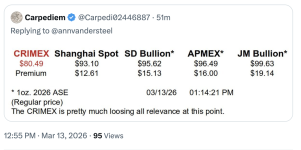
To be fair ASE's are hardly a bullion price. Because the mint doesn't do their job either.

- Messages
- 52
- Reaction score
- 53
- Points
- 88
I'm not up to speed on the industrial use of this carbon fiber, but it sounds like China made a significant breakthrough on manufacturing it:
Too funny. Not sure of the origin of the "news", but that's an essentially irrelevant pseudo-advancement. Perhaps it is simply due to every new generation believing that they know better than their elders....
Japanese and American carbon fiber producers have known how to produce higher tensile strength carbon fiber for at least 30, if not 40, years. They stopped further development of that property at the "T1000" level because practical use of carbon fiber in structures is largely limited by it's maximum compressive strength (which is a complicated failure mode), not the tensile strength. Compressive strength of carbon fiber plateaued many decades ago.
A "run" on banks??
Corporate bank runs won't last as the Fed will be there for them. Public bank runs... Fed says "go phuck yourselves".
- Messages
- 2,120
- Reaction score
- 2,548
- Points
- 283
3500 gold and 50 silver by end of the year.
- Messages
- 22,670
- Reaction score
- 12,723
- Points
- 288
Explains how the Exchange will never be caught short.
Says there is no shortage for Sprott.
The comments are entertaining...
In this video you'll discover:
 Why Rick Rule sold his physical silver position after it quadrupled and how he redeployed profits into silver mining stocks
How silver stocks were pricing in $45 silver while spot sat at $75 and what that gap means for investors
Why the COMEX silver squeeze will never work and how exchanges protect bullion banks through force majeure and cash settlement
Why JP Morgan and major bullion banks will never be caught physically short on silver
Why governments trying to control gold and silver markets always create the opposite effect
Says there is no shortage for Sprott.
The comments are entertaining...
"This Event Changed My Entire 2026 Silver Prediction" - Rick Rule
Rick Rule breaks down why gold and silver are entering a historic inflection point. With gold surging to $5,300 after Iran tensions and silver flushing 5% lower, Rick reveals exactly why this divergence is what disciplined precious metals investors have been waiting for.In this video you'll discover:
Why Rick Rule sold his physical silver position after it quadrupled and how he redeployed profits into silver mining stocks How silver stocks were pricing in $45 silver while spot sat at $75 and what that gap means for investors Why the COMEX silver squeeze will never work and how exchanges protect bullion banks through force majeure and cash settlement Why JP Morgan and major bullion banks will never be caught physically short on silver Why governments trying to control gold and silver markets always create the opposite effect
- Messages
- 22,670
- Reaction score
- 12,723
- Points
- 288
- Why now: Business Roundtable, big banks, and investor groups have lobbied hard for years — claim quarterly cadence forces short-termism, stock buybacks over R&D, and punishes long-term strategy.
- Market reaction preview: S&P 500 futures ticked up slightly on the leak; growth/tech names (Apple, Tesla, Nvidia) love the idea — less pressure to beat every 90 days. Value/defensive stocks could take a hit from reduced transparency.
- Historical context: Quarterly reporting became mandatory under SEC rules in the 1970s (post-Watergate transparency push). Europe/Australia already allow semi-annual for many firms; US would be catching up, not leading.
- Downside risks: Retail investors & analysts lose granular data flow — harder to spot red flags early (think Enron-level fraud could hide longer). Volatility might actually rise on semi-annual “surprise” bombshells instead of smoothed quarterly beats/misses.
- Political angle: Trump-era dereg push + current SEC chair (Atkins incoming?) aligns perfectly. Proposal likely out for comment soon; full rule change could take 12–18 months if it survives pushback from institutional investors who rely on frequent updates.
In the meantime, the RBA (Rothschild Banking Authority) here increased rates by 0.25% yesterday.
- Messages
- 22,670
- Reaction score
- 12,723
- Points
- 288
Gold and Silver Miners: There are Index changes coming up shortly. I name the companies.
This quarter, major stock market indicies get revised or re-balanced.The MarketVector Global Gold Miners Index (MVGDX) will add 4 gold and silver mining stocks this Friday 20th March.
The S&P/ASX 100 Index will add 3 precious metals stocks on Monday 23rd March.
- Messages
- 22,670
- Reaction score
- 12,723
- Points
- 288
Yeah, it's Asian Guy but he's quoting accurate data...
Bill’s Commentary
“I feel I need to comment on this video:
STOP IGNORING WHAT HOLTER IS SAYING - HIS LAST 3 PREDICTIONS WERE 100% ACCURATE...
I have no idea who is behind ‘John AG,’ but as I have previously written regarding his other videos, I believe he is about 90% correct. Most of his errors are dates and timelines. I assure you I never ever talk about price and dates at the same time, he is mistaken on his timeline to $50, and I certainly never gave out any date(s) as to when it would occur. I have publicly said many times that silver should have pierced $50 many years ago but did not due to outright manipulation, of this we have proof. I also did not predict $120 in January, however, I did say that $100 seemed to be a logical price target when silver traded $65-70. His broad strokes on economic/financial/derivatives are very sound, and I believe to be correct. Warren Buffet calls derivatives “weapons of mass financial destruction;” it will be derivatives that crater the entire financial system. Of this, I am 100% confident because math is math and it does not lie.
While it is nice that someone put together a “puff piece” on me, I did not make the calls he claims. I am a broad picture guy and take an aerial view. I moved to Texas in the late 80’s during the oil bust and bought a foreclosed, 6-month-old 4,000 sq/ft house on water for $139,000. Back in 1997 when gold dropped below $335 it was game on for me because the cost of production was about $350. Any time you can buy something below the cost of construction/production, you will make money. I also “retired” and left the United States in Nov. 2006. Three Bear Stearns hedge funds gated investors in February 2007. This was good timing for what was to come and a very difficult decision because I had built up one of the largest physical gold, silver, and mining share positions in the US for a retail broker. I continue to accumulate physical metals for clients and have done so since returning to the US in 2011. And while we are on predictions, I should say that most of our “conspiracy theories” have turned out to be conspiracy facts -proven facts.
Lastly, trying to predict “price and time” is a fool’s game. The only thing you need to know is that when derivatives detonate, it is game over! You are either in, or out. There will be few scraps left of whatever you held in the system, and buying gold or silver will not be an option because there will be none for sale. THAT’S my prediction!”
Bill’s Commentary
“I feel I need to comment on this video:
STOP IGNORING WHAT HOLTER IS SAYING - HIS LAST 3 PREDICTIONS WERE 100% ACCURATE...
I have no idea who is behind ‘John AG,’ but as I have previously written regarding his other videos, I believe he is about 90% correct. Most of his errors are dates and timelines. I assure you I never ever talk about price and dates at the same time, he is mistaken on his timeline to $50, and I certainly never gave out any date(s) as to when it would occur. I have publicly said many times that silver should have pierced $50 many years ago but did not due to outright manipulation, of this we have proof. I also did not predict $120 in January, however, I did say that $100 seemed to be a logical price target when silver traded $65-70. His broad strokes on economic/financial/derivatives are very sound, and I believe to be correct. Warren Buffet calls derivatives “weapons of mass financial destruction;” it will be derivatives that crater the entire financial system. Of this, I am 100% confident because math is math and it does not lie.
While it is nice that someone put together a “puff piece” on me, I did not make the calls he claims. I am a broad picture guy and take an aerial view. I moved to Texas in the late 80’s during the oil bust and bought a foreclosed, 6-month-old 4,000 sq/ft house on water for $139,000. Back in 1997 when gold dropped below $335 it was game on for me because the cost of production was about $350. Any time you can buy something below the cost of construction/production, you will make money. I also “retired” and left the United States in Nov. 2006. Three Bear Stearns hedge funds gated investors in February 2007. This was good timing for what was to come and a very difficult decision because I had built up one of the largest physical gold, silver, and mining share positions in the US for a retail broker. I continue to accumulate physical metals for clients and have done so since returning to the US in 2011. And while we are on predictions, I should say that most of our “conspiracy theories” have turned out to be conspiracy facts -proven facts.
Lastly, trying to predict “price and time” is a fool’s game. The only thing you need to know is that when derivatives detonate, it is game over! You are either in, or out. There will be few scraps left of whatever you held in the system, and buying gold or silver will not be an option because there will be none for sale. THAT’S my prediction!”

Yeah, it's Asian Guy but he's quoting accurate data...
Bill’s Commentary
“I feel I need to comment on this video:
STOP IGNORING WHAT HOLTER IS SAYING - HIS LAST 3 PREDICTIONS WERE 100% ACCURATE...
I have no idea who is behind ‘John AG,’ but as I have previously written regarding his other videos, I believe he is about 90% correct. Most of his errors are dates and timelines. I assure you I never ever talk about price and dates at the same time, he is mistaken on his timeline to $50, and I certainly never gave out any date(s) as to when it would occur. I have publicly said many times that silver should have pierced $50 many years ago but did not due to outright manipulation, of this we have proof. I also did not predict $120 in January, however, I did say that $100 seemed to be a logical price target when silver traded $65-70. His broad strokes on economic/financial/derivatives are very sound, and I believe to be correct. Warren Buffet calls derivatives “weapons of mass financial destruction;” it will be derivatives that crater the entire financial system. Of this, I am 100% confident because math is math and it does not lie.
While it is nice that someone put together a “puff piece” on me, I did not make the calls he claims. I am a broad picture guy and take an aerial view. I moved to Texas in the late 80’s during the oil bust and bought a foreclosed, 6-month-old 4,000 sq/ft house on water for $139,000. Back in 1997 when gold dropped below $335 it was game on for me because the cost of production was about $350. Any time you can buy something below the cost of construction/production, you will make money. I also “retired” and left the United States in Nov. 2006. Three Bear Stearns hedge funds gated investors in February 2007. This was good timing for what was to come and a very difficult decision because I had built up one of the largest physical gold, silver, and mining share positions in the US for a retail broker. I continue to accumulate physical metals for clients and have done so since returning to the US in 2011. And while we are on predictions, I should say that most of our “conspiracy theories” have turned out to be conspiracy facts -proven facts.
Lastly, trying to predict “price and time” is a fool’s game. The only thing you need to know is that when derivatives detonate, it is game over! You are either in, or out. There will be few scraps left of whatever you held in the system, and buying gold or silver will not be an option because there will be none for sale. THAT’S my prediction!”
FWIW.......all the "Asian John" youtube channels remind me of the tech stock pump n dump schemes before the dot com crash in 2000 ...... just the volume of the channels all basicly pumping metals in one form or another reaks of a boiler room pumping out propaganda ...... obviously they have many choir members to preach to ......
Just tossing out my opinion..... and yes i watch some of the Asian John channels with a warry eye

Viking
Yellow Jacket
Big sell off.