
Dinosaurs found on distant planet!

Welcome to the Precious Metals Bug Forums

Welcome to the PMBug forums - a watering hole for folks interested in gold, silver, precious metals, sound money, investing, market and economic news, central bank monetary policies, politics and more.

Why not register an account and join the discussions? When you register an account and log in, you may enjoy additional benefits including no Google ads, market data/charts, access to trade/barter with the community and much more. Registering an account is free - you have nothing to lose!

They’ve detected sulfur-based molecules in the atmosphere of exoplanet K2-18b that, on Earth, are only produced by living organisms. While the evidence isn’t conclusive yet, it matches predictions for a “Hycean” world — one potentially covered in oceans and capable of hosting microbial life. If further observations confirm these findings, it could mark a turning point in our search for extraterrestrial life.
...

We've found the Empire's clone manufacturing planet Kamino.
 
I find it hard to believe scitechnews would be the first to report such groundbreaking news.
 
Once the warp drives come online we should be able to travel there pretty quickly. Warp 9.9 is like 3000 times the speed of light. Be cool to run over and grab some photos to see how they are evolving.

Even better would be my idea of an expandable telescope. Space based of course. Similar to James Webb but expandable infinitely. Eventually we get to the point where we can see minute details of far away planets. Could be paid for by people on earth subscribing to different channels of different planets. Imagine we find 100 or 100,000 planets teaming with life that we can view by changing the channel. Real reality TV.
 
Hijacking the thread - similar topic, different planet / discovery:
One of the worlds in the TRAPPIST-1 system, a mere 40 light-years away, just might be clad in a life-supporting atmosphere.

In exciting new JWST observations, the Earth-sized exoplanet TRAPPIST-1e shows hints of a gaseous envelope similar to our own, one that could facilitate liquid water on the surface.

Although the detection is ambiguous and needs extensive follow-up to find out what the deal is, it's the closest astronomers have come yet in their quest to find a second Earth.

"TRAPPIST-1e remains one of our most compelling habitable-zone planets, and these new results take us a step closer to knowing what kind of world it is," says astronomer Sara Seager of the Massachusetts Institute of Technology (MIT), co-author on one of two papers detailing the findings.
...
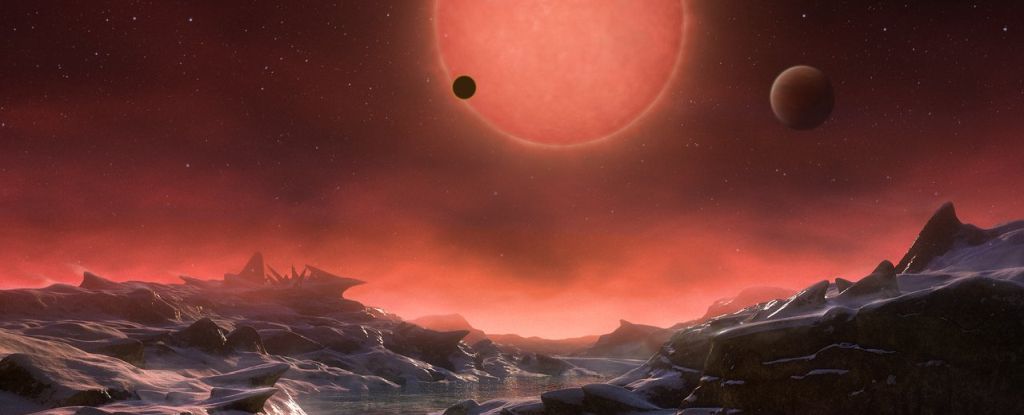

"a mere 40 light-years away"

:ROFLMAO:
 
Measuring the light of the star as it passes thru a planets atmo ? Fascinating really.

We are probably one generation away from being able to confirm such finds. The Webb and a few others will begin the process but to really confirm is probably 30 years down the road, a road most likely paved with silver. But once we can confirm the presence of oxygen, nitrogen, carbon dioxide, methane,ozone, and especially Chlorophyll, H2O, well that pretty much seals the deal then doesn't it ? If we can also detect argon and nitrous oxide along with sulfur dioxide then we'll know we've found an Industrialized society as well, probably able to pick up signals from earth

And this WILL happen. Measuring a planets light spectrum is a proven method of detecting life. We likely already have and Govt.'s just haven't released the findings figuring were not mature enough to draw our own conclusions. And likely we've been visited already in the form of robotic inter-Galactic drones and A.I. . This science is almost within our reach so why not another society a few leaps ahead of us ? And since we have a shoot first policy they probably figure were barbarians not worth 1st contact, and they are probably right.

The Galaxy and universe is so massive its only a matter for time tho isn't it ? What makes us think were so special ? We share over 98% of our DNA with Chimpanzee's and are litterly a few million years down the road from Ape-hood. Science, like its use of silver for it, is a exponential process. It moves faster and faster, and gets larger and larger, as time passes. The only reason we dont have more answers right now is because we've lacked the national will to spend the $ needed for space exploration.

But thats changing while in fact the evolution of science has never slowed down, let alone stopped. I believe the Galaxy is filled with life, let alone the universe. The only question is how and Will we find it, hopefully ASAP.
;)
 
Back
Top Bottom