

Ars Technica
A man in his 20s showed up to a UK hospital with the hilt of a knife sticking out of his face. The 15 mm-wide blade hidden within went completely through his right eye and through his brain, with the tip of the blade hitting the top of his skull.
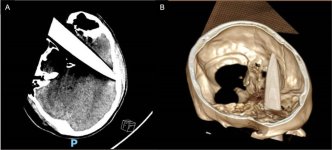
The blade was entirely through the right eye socket and eyeball. It traversed the left frontal and temporal lobes of his brain, passing through in front of—and without apparently injuring—the corpus callosum, which connects the two sides of the brain and is full of nerve fibers. The blade also missed the left internal capsule, which holds another bundle of nerve fibers.
Doctors pulled knife from man’s eye rather than invasively excavate it. After it was out, the doctors saw no signs of significant hemorrhaging. The brain wound was cleaned and drained before surgeons patched up his skull. His right eye, however, couldn’t be saved. Given its extensive damage, it was removed. The man then moved to intensive care, where he recovered rapidly.
He developed some minor right-side weakness, but it resolved two days later. Scans of his brain showed steady improvement—a little bleeding and swelling, and there was some air in his brain tissue from where the knife had been. But otherwise, it appeared to be healing. He developed no infections and had no seizures.
A man in his 20s showed up to a UK hospital with the hilt of a knife sticking out of his face. The 15 mm-wide blade hidden within went completely through his right eye and through his brain, with the tip of the blade hitting the top of his skull.
The blade was entirely through the right eye socket and eyeball. It traversed the left frontal and temporal lobes of his brain, passing through in front of—and without apparently injuring—the corpus callosum, which connects the two sides of the brain and is full of nerve fibers. The blade also missed the left internal capsule, which holds another bundle of nerve fibers.
Doctors pulled knife from man’s eye rather than invasively excavate it. After it was out, the doctors saw no signs of significant hemorrhaging. The brain wound was cleaned and drained before surgeons patched up his skull. His right eye, however, couldn’t be saved. Given its extensive damage, it was removed. The man then moved to intensive care, where he recovered rapidly.
He developed some minor right-side weakness, but it resolved two days later. Scans of his brain showed steady improvement—a little bleeding and swelling, and there was some air in his brain tissue from where the knife had been. But otherwise, it appeared to be healing. He developed no infections and had no seizures.