Military Subjects & War Stories (Incldg the Cold War)

Welcome to the Precious Metals Bug Forums

Welcome to the PMBug forums - a community supported watering hole for folks interested in gold, silver, precious metals, sound money, investing, market and economic news, central bank monetary policies, politics and more.

Register a free account to join the discussions. When you register an account and log in, you may enjoy additional benefits including access to market data/charts and additional members only rooms (including one for trade/barter with the community).

The playboy who inherited the world’s most notorious mercenary force​

KAMPALA, Uganda—Pavel Prigozhin was still learning the family guns-for-hire business when his father’s private jet exploded 28,000 feet over Russia.

Yevgeny Prigozhin’s very public death, following his very public falling-out with President Vladimir Putin, left his son, Pavel, in charge of the world’s most notorious mercenary force. At age 25, he inherited Wagner Group, an empire of gunfighters, gold smugglers, opioid dealers, brewers and vodka distillers.

Once seen as a pampered playboy, he turned out to be a natural.

Pavel Prigozhin, now 28, not only salvaged but expanded operations in Wagner’s African stronghold, the Central African Republic, according to former Wagner associates, government officials, business people and researchers in Bangui, the capital city.

More:

https://www.msn.com/en-us/news/othe...-mercenary-force/ar-AA2esaQm?ocid=socialshare
 
Hitler's Forgotten FIRST Jail Term

Oct 18, 2026
Everyone knows that Hitler was sent to jail after the 1923 Beer Hall Putsch, but few knew that it was actually Hitler's second prison term, he having been given a 3-month jail term earlier in his political career. Find out why Hitler was first sent to prison.


9:27
 

USNI News Western Pacific Pulse: Oct. 16, 2026​


Army Lays Out New Plan for Prolonged Fight in First Island Chain​

The U.S. Army laid out its plans to prepare for a prolonged fight in the Pacific along the First Island Chain in the service’s new warfighting guidance released this month.

For decades, the ground branch has oriented troops against insurgent threats and high-intensity combat operations from the Middle East, Europe and the Korean Peninsula. In recent years, tensions in the Western Pacific with China have pushed the Army to formulate plans for a new type of operations area – one that encompasses vast swathes of archipelagos and maritime environments.

More:


Skorzeny's Last Battle - The Oder Bridgehead 1945 (OMNIBUS EDITION)

Oct 22, 2026
In early 1945, Hitler's commando leader Otto Skorzeny was detailed by Himmler to create and hold a bridgehead over the Oder River, Germany's last water barrier before Berlin as Himmler planned to use it to launch a counter-offensive and stop the Soviets. This was the Schwedt Bridgehead and this is its story.


26:13
 

Ukraine’s reliance on Starlink carries a chilling lesson from the Second World War​

Last week, the problem of Ukraine’s dependence on a single technology – Elon Musk’s Starlink internet system (which uses satellites in low Earth orbit to provide connectivity, particularly across remote areas and battlefields) – reared its ugly head.

The military version of the system, Starshield, had been used by Ukraine for months to intercept killer Russian missiles and drones and destroy far-off targets deep inside Vladimir Putin’s country – all at lightning speed.

That was until Ukraine’s access was restricted amid an ongoing row with President Trump. Cue recriminations: Musk blaming the White House for the slowdown, and other sources telling The Telegraph that it was the Tesla boss himself who had the idea.

More:

https://www.msn.com/en-us/news/othe...second-world-war/ar-AA2g1zaJ?ocid=socialshare
 

USNI News Western Pacific Pulse: Oct. 30, 2026​


Russia, North Korea Test Missiles in the Western Pacific​


Russia and North Korea carried out ballistic missile launches this week with Russia conducting a launch of a Submarine-Launched Ballistic Missile (SLBM) from the Western Pacific to Russia arctic region, according to a Russian Ministry of Defence (MOD) release on Wednesday while North Korea carried out launches of Short-Range Ballistic Missiles (SRBMs) as part of a firepower demonstration for North Korea leader Kim Jong Un during an exhibition of unmanned aerial vehicle technology.

Nuclear powered ballistic missile submarine (SSBN) RFS Generalissimus Suvorov (K-553), assigned to the Russian Navy Pacific Fleet, launched a RSM-56 Bulava SLBM from the sea of Okhotsk at the Chizha test site in the Arkhangelsk region of northwest Russia.

More:


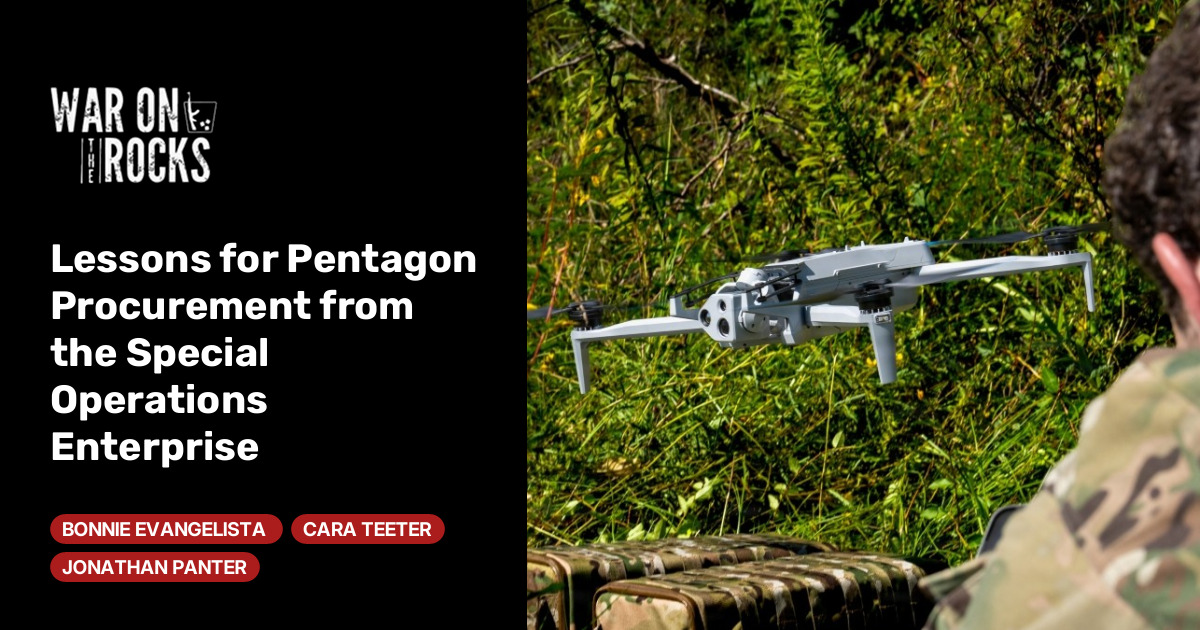
Defense Primer on U.S. Special Operations Forces​

The following is the Nov. 3, 2026, Congressional Research Service report Defense Primer: U.S. Special Operations Forces.

From the Report​

U.S. Special Operations Forces (SOF) are active duty and reserve components of the military services that are designated as SOF by the Secretary of Defense, who is using “Secretary of War” as a “secondary title” under Executive Order (EO) 14347, dated September 5, 2025. SOF are selected, organized, trained, and equipped to conduct and support special operations. Special operations frequently require unique modes of employment, tactics, techniques, procedures, and equipment. SOF often conduct special operations in hostile, politically, and/or diplomatically sensitive environments. Special operations are characterized by one or more of the following: being time-sensitive and/or clandestine, occurring in low-visibility conditions, happening with or through indigenous forces, requiring regional orientation and cultural expertise, or carrying a high degree of risk. SOF’s core activities are:

More:

 
If you want to know why the Pentagon is watching Ship 42’s reentry trajectory today just as closely as NASA, look at what full Starship reusability does to global military logistics.

Right now, moving 100 tons of heavy equipment across the planet requires aircraft carriers, overseas airbases, diplomatic overflight clearances, and days of transit time.

Once Starship proves repeatable tower-to-tower recovery:
> The U.S. military gains the ability to drop 100+ tons of cargo, autonomous drone swarms, or mobile defense grids anywhere on Earth in under 45 minutes, without asking a single neighboring country for airspace permission.
> Combined with SpaceX’s $100B second Starbase complex in Louisiana (designed for up to 10,000 launches a year), heavy orbital lift becomes a strategic deterrent on par with nuclear submarines.

I bet that within 3 years of Starship’s first successful upper-stage catch, every major geopolitical power will be forced to rewrite its defense doctrine around suborbital rapid response.


🔥 SpaceX & Starlink Teams Go Crazy as Starship Flight 15 is Caught Mid-Air after 22-Hour Flight​

 
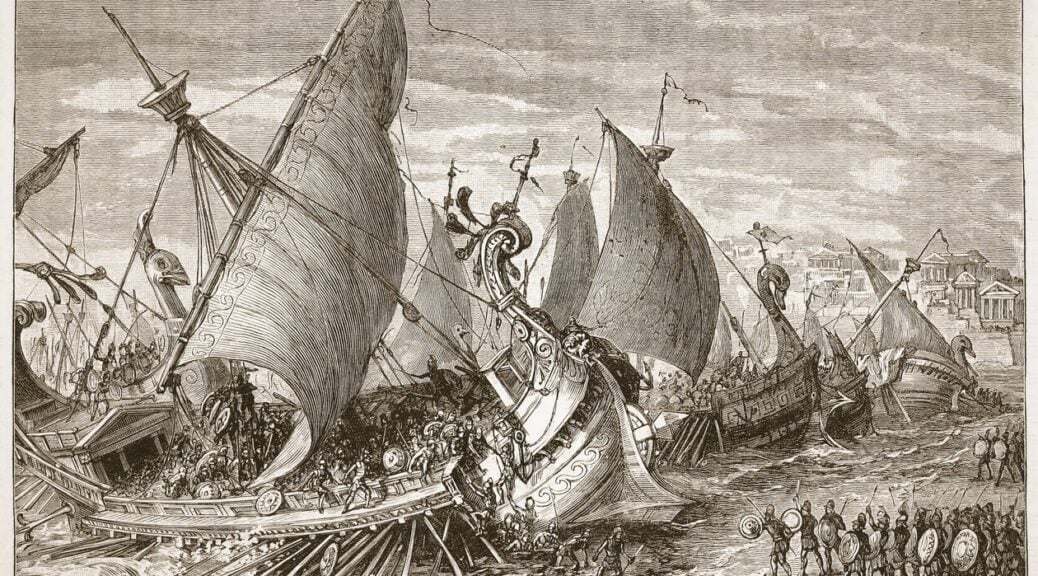
The Battle of Teutoburg Forest (9 AD)

Teutoburg Forest - The battle that stopped the Roman Empire

Arminius (18/17 BC – AD 21) was a chieftain of the Germanic Cherusci tribe who famously led an allied coalition of Germanic tribes to a decisive victory against three Roman legions in the Battle of the Teutoburg Forest in 9 AD. An auxiliary lieutenant to the Roman general Publius Quinctilius Varus, Arminius used his knowledge of Roman tactics to ambush and destroy the legions.

Arminius 2.jpg​

The German tribes' victory against the Roman legions in the Teutoburg forest had a far-reaching effect on the subsequent history of both the ancient Germanic peoples and on the Roman Empire. The Romans were to make no more concerted attempts to conquer and permanently hold Germania beyond the river Rhine. Modern historians have regarded Arminius's victory as "Rome's greatest defeat" and one of the most decisive battles in history.

Herbst im Teutoburgerwald (Tb Forest in Autum).jpg

Continued.jpg​
 
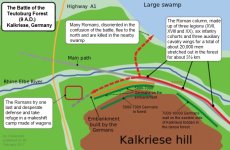
In September, 9 A.D, Publius Quinctilius Varus led three Roman legions through the Teutoburg Forest from the Weser River towards their more permanent bases along the Rhine. 20,000 soldiers accompanied by 10,000 others, mostly women, but also traders, medicians, and slaves. Roman General Varus as a representative of Romans hoped to expand Roman power, Roman law, and Roman culture on the north of Europe. The conditions presented heavy rains and dense fog in an already thickly wooded forest, which in addition to the narrow trails prevented the Romans from marching in standard battle formations. On this day, Varus led his legions through this unknown territory of densely forested terrain to investigate supposed uprisings among local German tribes, a mistake that he would eventually pay dearly for.

Teutoburg Forest Map.jpg​

Varus had an extensive reputation for cruelty and ruthlessness towards Germanic culture and peoples. He was highly revered by the Roman senate and subsequently feared by the Germans, showing incredible arrogance towards the Germans and pursuing heavy taxation policies that threatened the decentralized form of government they practiced. An esteemed military leader, his army boasted 15,000 experienced legionnaires, and he led three legions known as the 17th, 18th, and 19th legions that were supplemented by German allied troops including Arminius, the son of a Cheruscan chief who was trained as a military commander serving under Varus’ command. He felt safe and sure, as he trusted advises of his Germanic friend, Arminius. Arminius, born in 18 or 17 BC, had obtained Roman citizenship as well as the status of equestrian (petty noble), he knew Latin.

Waiting In the Forest.jpg

Continued.jpg​
 
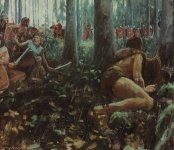
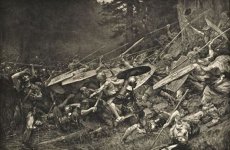
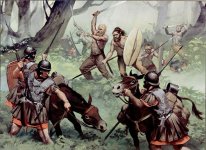
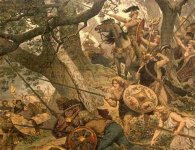
The way grew narrow, the Roman convoy had to change it's formation, The line of march was now stretched out perilously long – between 15 and 20 kilometers. Ahead, Germanic warriors waited in grim silence. Meanwhile, a violent rain and wind came up that separated the column still further, while the ground, that had become slippery around the roots and logs, made walking very treacherous for them, and the tops of the trees kept breaking off and falling down, causing much confusion. While the Romans were in such difficulties, the barbarians suddenly surrounded them on all sides at once. At one moment 20,000 spears were in the air aiming at Romans. Arminius set an ambush.

Battle of the Teutoberg Forest-5.jpg​

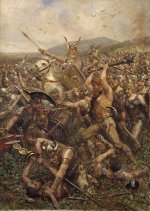
While serving as a commander of auxiliary forces under the Romans, Arminius, secretly recruited German tribesmen under his command to plot an attack against Varus. Knowing that the Romans were disadvantaged on unfamiliar terrain, Arminius deceptively convinced Varius to move his troops through the Teutoburg Forest as he furtively coalesced his own army of troops to launch an ambush onto Varius’ path. Although lacking in overall strength and size compared to the Romans, the German troops consisted of able-bodied freemen. They fought effectively with shields, swords, and spears, which proved to be more powerful than the weapons that the Romans were equipped with. Led by Arminius, German troops ambushed the army during their march through the forest and were able to directly counter Roman military moves due to Arminius’ knowledge of Roman military tactics, relentlessly attacking Varius’ dispersed legions.

Teutoberg Forest 2.jpg

Continued.jpg​
 
Otto Albert Koch Varusschlacht.jpg​

Continuing their attack, the Germans took advantage of the Romans’ foreignness to the terrain and constructed a trench and wooden barrier built to its sides. As Varus led his army through this preset trap after fleeing their previous attack, German troops bombarded the legions with arrows and spears, continuing to press their forces on the wounded army until thousands of Romans were slain and the army essentially annihilated. An estimated 15,000 to 20,000 Romans were killed as a result, provoking far-reaching consequences for the Roman Empire and a history-altering revolution for the Germans. With a portion of their great imperial army destroyed, the Roman’s vast reputation of invincibility was devastated.

Attack 1.jpg​

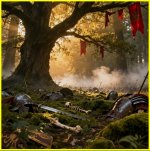
The battle of Teutoborg forests ended Roman expansion in Northern Europe. Six years would pass before a Roman army would return to the battle site. The scene the soldiers found was horrific. Heaped across the field at Kalkriese lay the whitening bones of dead men and animals, amid fragments of their shattered weapons. In nearby groves they found “barbarous altars” upon which the Germans had sacrificed the legionnaires who surrendered. Human heads were nailed everywhere to trees.

Bonesss.jpg

Continued.jpg​
 
Back
Top Bottom