Military Subjects & War Stories (Incldg the Cold War)

Welcome to the Precious Metals Bug Forums

Welcome to the PMBug forums - a community supported watering hole for folks interested in gold, silver, precious metals, sound money, investing, market and economic news, central bank monetary policies, politics and more.

Register a free account to join the discussions. When you register an account and log in, you may enjoy additional benefits including access to market data/charts and additional members only rooms (including one for trade/barter with the community).

How Professional Wrestling Bodyslamed The Cold War

Nov 22, 2026 150 hype points
Our historical documentary series on the history of the Cold War continues with an examination of how The Cold War was reflected in popular culture, namely professional wrestling in the 1980s. We look at how the WWF showed many of the core traits of Reaganism and of the xenophobia of the United States.


29:21

*SOURCES*
- Scott Beekman “ringside: A History of Professional Wrestling in America”, Praeger, 2006

- Broderick Chow, Eero Laine and Claire Warden, “Hamlet Doesn’t Blade: Professional Wrestling, Theater, and Performance” from “Performance and Professional Wrestling” edited by Broderick Chow, Eero Laine, and CLaire Warden”, Routledge, 2017

- Morgan Daniels, “Some Moments of Flag Desecration in Professional Wrestling”, from “Performance and Professional Wrestling” edited by Broderick Chow, Eero Laine, and CLaire Warden”, Routledge, 2017

- Shawn Mazer, “The Game of Life”, from “Performance and Professional Wrestling” edited by Broderick Chow, Eero Laine, and CLaire Warden”, Routledge, 2017

- Vaughn May, “Cultural Politics and Professional Wrestling”, Studies in Popular culture, April 1999

- Scot Lucas, “Wrestling: The Mania is Back”, New STatesman, May 8, 2000

- Jens Kjelgaard-Christiansen, “Wrestling VOices: Amplifying Patriotism and Ethnic Stereotypes in 1980s American Professional Wrestling”, The Journal of American Culture, 49:2026

- Conor Heffernan, "Representations of hulk Hogan in the 1980s: Christianity, Masculinity, Xenophobia”, Arts, 12:22

- Nicholas Ryan Canada, “portrait of a Real American: Class, Masculinity, Race, and Ideology in American Professional Wrestling 1983-1993”, PhD Dissertation, Bowling Green 2022

- Zach Montellaro, “How Professional Wrestling Explains Donald Trump’s Washington”, Politico, April 19, 2025

- https://tamhussein.substack.com/p/the...
- https://bleacherreport.com/articles/2...
- https://www.politico.com/news/magazin...
- https://paulcantor.io/paul-cantor-wor...
- https://www.wwe.com/classics/russians...
 
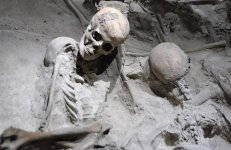
They enter the doleful scene, hideous in appearance and association. The first camp of Varus appeared in view. The extent of ground and the measurement of the principia left no doubt that the whole was the work of three legions. After that a half-decayed rampart with a shallow foss, where their remains, now sadly reduced, were understood to have sunk down. In the intervening portion of the plain were whitening bones, either scattered or accumulated, according as they had fled or had made a stand. Near them lay fragments of javelins and limbs of horses. There were also skulls fixed upon the trunks of trees. In the adjacent groves were the savage altars, where they had immolated the tribunes and centurions of the first rank. Those who survived the slaughter, having escaped from captivity and the sword, related the sad particulars to the rest: “Here the commanders of the legions were slain; there we lost the eagles; here Varus had his first wound; there he gave himself another, and perished by his own unhappy hand. In that place, too, stood the tribunal whence Arminius harangued. How many gibbets he erected for the execution of his captives; what trenches he dug; and how, in proud scorn, he made a mock at the standards and eagles.”

bones.jpg​

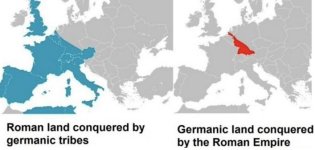
Marked as one of the most prominent battles and catastrophic defeats of the Roman Empire, the Battle of Teutoburg Forest simultaneously hindered the march of the Roman Empire into Northern Europe and halted the conquest of Germany. It is without doubt that the Germans’ victory successfully allowed them to evade Roman expansion and rule indefinitely, potentially altering the course of history and illustrating a significant turning point in the Roman Empire’s imperialistic conquest. Known as Rome’s greatest defeat, the Battle of Teutoburg Forest held an enormous impact, threatening the survival of the Roman Empire and successfully preventing the Romanticization of German territory.

Conqured Lands.jpg​

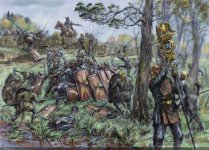
When they wiped out Varus' army, the Germanic tribesmen also captured the three legions' eagle-bearing standards, which were religious objects held sacred under the Roman national cult. Thus, once memory of the defeat faded a bit, the Romans attached some importance and a great deal of national pride to their recovery.

Eagle.jpg
​
After Augustus' death, his stepson Tiberius (born 42 BC, ruled 14-37 AD) suceeded him as emperor, and Tiberius' nephew Germanicus (16/15 BC - 19 AD) was made military commander in charge of Germany. Germanicus scored a number of victories east of the Rhine, weakening the coalition Arminius mounted against the Romans and retrieving two of the lost eagles. The final eagle wasn't recovered until 41 AD, during the reign of the Emperor Claudius (born 10 BC, ruled 41-54 AD).
=====================

Ranks #7 on Greatest Milatary Blunders of All Time.


Gold Coinns Found at Battle Site


For you non-readers —


Done.jpg

​
 
Back
Top Bottom