


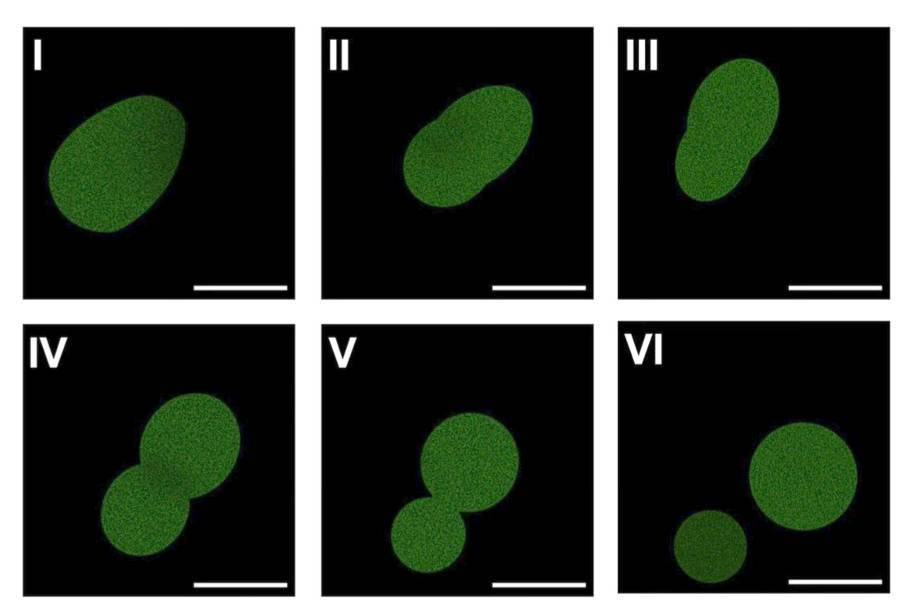
It’s just a microscopic water droplet surrounded by a fatty membrane and stuffed with chemicals and snippets of DNA encoding a mere 36 genes. But it’s also arguably the closest researchers have come to building a living cell from scratch. In work posted online today, University of Minnesota Twin Cities synthetic biologist Kate Adamala and her team show their creation, nicknamed SpudCell, can grow by fusing with other droplets, replicate its genome, and divide.
“This is a stunning scientific achievement,” says Roseanna Zia, a computational cell biologist at the University of Missouri. But researchers note that SpudCell remains far from a living cell, as it can’t divide over many generations or evolve.
Some have also grumbled about Adamala’s efforts to draw attention to the work, which she says was rejected by Cell after one reviewer said SpudCells were not real biology. She then sent the 190-page manuscript to journalists, under embargo, even before she had uploaded it to the preprint server bioRxiv, where her colleagues could read and assess it. She says her group will submit it to a new journal soon. “It’s an unusual way of doing things,” says Kerstin Göpfrich, a synthetic biologist at Heidelberg University.
Researchers have long dreamed of creating cells in the lab, to both understand life’s fundamentals and produce cells that can be better engineered to make certain compounds. But most have set their sights lower and tried to replicate individual cell functions, such as feeding or growth. Putting multiple functions together has been extremely challenging, because each tends to work best under a different set of conditions, for instance a certain amount of magnesium or a specific level of acidity. “Being able to incorporate all of these modules together in a synthetic cell is the feat that the field has been waiting for,” says Job Boekhoven, a systems chemist at the Technical University of Munich, although he stresses that the new paper’s claims need to be peer reviewed.
...
More:
Academic expert commentary:
Scientists in the United States claim to have built a synthetic cell that can feed and reproduce
The team led by scientist Kate Adamala of the University of Minnesota has released the news—under an embargo—to several media outlets regarding the creation of a synthetic cell capable of feeding, growing, and replicating, which they have named Spudcell. Their work, which, according to Science...