

ZME Science
On July 9, 1968, eight white mice entered what was supposed to be paradise. A colony supplied with endless food, water, shelter and safety ended in violence and extinction.
Universe 25 became one of those studies that seemed to explain whatever people already believed. To some, it proved that overcrowding would destroy modern cities. To others, it showed that comfort breeds decadence, welfare erodes ambition or social isolation leads inevitably to demographic collapse.
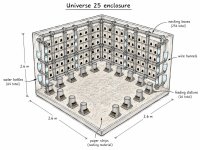
John B. Calhoun built Universe 25 at the National Institute of Mental Health in Maryland. The enclosure was a square measuring about 2.6 metres on each side, surrounded by walls roughly 1.4 metres high. The upper portions were smooth enough that the mice couldn’t climb out.
For 104 days, the eight founders explored and adjusted to their new settlement. The population began to climb with astonishing speed. It doubled roughly every 55 days: 20 mice became 40, then 80, 160, 320. By experimental day 315, about 620 mice lived inside the enclosure.
+====+====+====+====+====+====+====+====+====+====+
The whole story is kinda complex, follow the link to see what I mean…
On July 9, 1968, eight white mice entered what was supposed to be paradise. A colony supplied with endless food, water, shelter and safety ended in violence and extinction.
Universe 25 became one of those studies that seemed to explain whatever people already believed. To some, it proved that overcrowding would destroy modern cities. To others, it showed that comfort breeds decadence, welfare erodes ambition or social isolation leads inevitably to demographic collapse.
John B. Calhoun built Universe 25 at the National Institute of Mental Health in Maryland. The enclosure was a square measuring about 2.6 metres on each side, surrounded by walls roughly 1.4 metres high. The upper portions were smooth enough that the mice couldn’t climb out.
For 104 days, the eight founders explored and adjusted to their new settlement. The population began to climb with astonishing speed. It doubled roughly every 55 days: 20 mice became 40, then 80, 160, 320. By experimental day 315, about 620 mice lived inside the enclosure.
+====+====+====+====+====+====+====+====+====+====+
The whole story is kinda complex, follow the link to see what I mean…