


In late spring 2020, a source I knew to be reliable called me with a story. The Dutch government had hacked into Jared Kushner’s phone and monitored him as he accessed a Dubai-based bank account. What was odd, the source said, was that the money in the account—hundreds of millions of dollars—had come from a bank in Azerbaijan. Most importantly, Kushner appeared to have transferred significant amounts of money from the Dubai account to other individuals, including a warlord, a mercenary and a one-time hit man. The story sounded preposterous, I told my source. And yet.
Six months later, I found myself speaking with someone else about the UAE government and their use of mercenaries in conflicts around the Middle East and Africa when I asked, on a whim, whether they knew anything about Kushner and bank transfers from a UAE account. My acquaintance grew quiet. Then they replied, “Yes.”
Over the next four years, I came to learn that, sometime in late 2017, the Netherlands Defense Intelligence and Security Service (MIVD) made a startling discovery. A General Staff of the Armed Forces of the Russian Federation (GRU) operative, a dark web hacker specializing in stolen bank data, was traveling to the UK for an espionage mission. They reached out to the British government for permission to apprehend him when he arrived. The British agreed.
When the Russian national arrived in England, the Dutch informed him that he had two options: he could work for them against the GRU, or the British would arrest him. Once in UK government custody, the operative would be charged with espionage. If convicted, he would spend years in a British prison. The Russian chose to change his employer.
Later that year, the Russian operative gave the Dutch spies access to one of the GRU’s most sensitive assets. Located in Rostov, Russia, the GRU’s hacking and cyber team operated a remote server on which they stored some of their bounty. During their search through these secret files, the Dutch found something astonishing: screenshots of Jared Kushner’s iPhone.
In The Hague, the MIVD hacking team tried to reverse engineer the Russian penetration of Kushner’s iPhone. Kushner owned what was then the latest model, the iPhone X. Released in November 2017, it featured Face ID, a state-of-the-art security feature that Apple had promoted at its launch. The Dutch team had been trying to pick the phone’s door lock, so to speak, when it occurred to them that the Russians may have found an unlocked window to gain entry instead. Their hypothesis was correct. By early 2018, the MIVD had found a vulnerability in the iPhone that gave them access. The security exploit wasn’t perfect, however. Some malware allows a hacker to turn a victim’s phone into a microphone and video camera, turn the phone on or off, and pull and add files. The Dutch solution did not provide that level of access. Instead, when Kushner used the phone, they could see his screen. Almost as soon as they got inside, the intelligence service began capturing every image of Kushner’s screen as he used it, filing their own cache of surveillance on their internal computer servers.
As they monitored Kushner’s phone, they discovered he used it to log in to a UAE bank account. By the time the Dutch spies had visibility into the phone, the account had received hundreds of millions of dollars from a bank in Azerbaijan. Their initial assessment was that the bank account was affiliated with the government there.
For the MIVD hackers, the bank account became an intelligence mystery to unravel. Nearly everything they worked on had a tinge of Russian conspiracy. A little over a year into Trump’s first presidency, the MIVD, like FBI agents and federal prosecutors in Washington working on the Robert Mueller investigation, had only part of the story.
Kushner, UAE ruler Mohamed bin Zayed (MBZ) and Mohammed bin Salman (MBS) of Saudi Arabia, converged at an auspicious moment. MBS wanted to be crown prince. MBZ wanted to blow up Obama’s Iran nuclear deal, and Kushner wanted both to help him force the Palestinians into a deal that Israel would accept. Despite the perception of his wealth, Kushner was not entirely financially independent of his parents, and the family business, Kushner Companies, faced a billion-dollar loan coming due on their trophy property, the Manhattan office building at 666 Fifth Avenue.
Early in the first Trump administration, MBZ and MBS offered to pay for a slush fund dedicated to helping the new administration with foreign policy goals. The idea was to help pay for Trump’s promised wall between Mexico and the US, for example, in an effort to secure a second term in the White House. The two Arab royals initially discussed with Kushner putting more than $10 billion into the effort. Within months, though, as MBZ pushed the Trump administration to help back MBS’s effort to become his country’s crown prince—and future king—the broader foreign policy slush fund idea fizzled. Instead, MBZ and MBS initially, and then MBZ alone, put at least $2 billion into at least two bank accounts for Kushner. It is unclear how the royals organized their $2 billion in combined payments, but they effectively split the cost. For the purposes of explanation, it is best to understand where and how each bank account was controlled.
...
More:

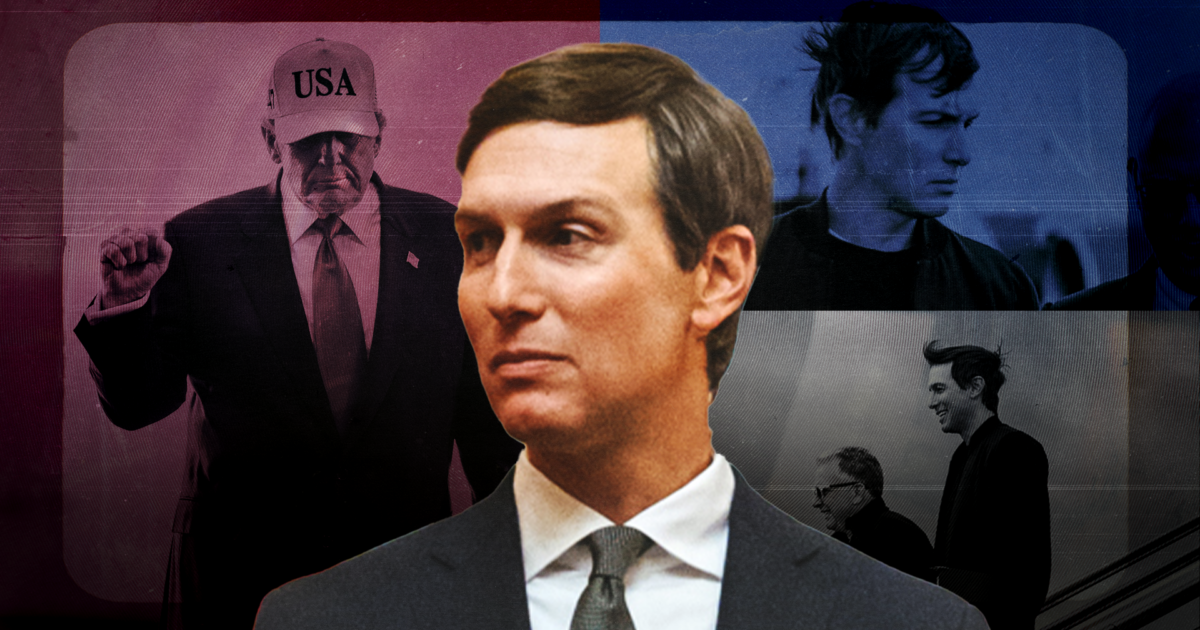
The Art of the Deal: Jared Kushner’s Hacked Phone Revealed More Than $700 Million in Transfers
An exclusive excerpt from ‘Princes and Thieves: Jared Kushner and Mohamed bin Zayed’s Secret Plot to Remake the Middle East’ examines how bank accounts linked the president’s son-in-law—and former senior adviser—to Israel, the UAE, and Saudi Arabia.
This story (apparently based upon a book that is now being published) will add fuel to the fire over the growing opposition to his role meddling in foreign affairs as a private citizen:
Jared Kushner, the president’s son-in-law and envoy, is breaking the law by acting as one of the country’s top diplomats without undergoing Senate confirmation or filing financial disclosures, according to a lawsuit filed today by Citizens for Responsibility and Ethics in Washington. The court must block Kushner from continuing to perform his outsized role and compel him to file his required financial disclosures.
Since early in the second Trump administration, Kushner has exercised significant diplomatic power at President Trump’s direction, meeting directly with foreign officials and representing the United States in the country’s efforts to end wars between the United States and Iran, Ukraine and Russia, as well as violent conflicts in the Middle East. Simultaneously, Kushner runs Affinity Partners, an investment firm with more than $6 billion in assets under management. Approximately 99% of those are owned by foreign investors, including the sovereign wealth funds of Saudi Arabia, Qatar and the United Arab Emirates. The firm also holds significant investments abroad, including in Israel.
Despite the power Kushner wields on behalf of the United States government, and the heightened risks from the substantial overlaps between his personal business interests and diplomatic role, Kushner has not faced Senate confirmation or filed a single financial disclosure—legal requirements that senior government officials are subject to.
The Constitution’s Appointments Clause requires that individuals who hold continuing government positions and exercise significant authority be vetted and approved by the Senate before they take office, and the Ethics in Government Act requires that individuals nominated to such positions, as well as other high-level government officials, file public financial disclosures. These laws apply to government officials whether they receive compensation or not.
...
More:
CREW sues to block Jared Kushner from acting as Trump envoy - CREW | Citizens for Responsibility and Ethics in Washington
Jared Kushner is breaking the law by acting as one of the country’s top diplomats without undergoing Senate confirmation or filing financial disclosures.
 www.citizensforethics.org


