2026 Crypto trading and market thread

Welcome to the Precious Metals Bug Forums

Welcome to the PMBug forums - a watering hole for folks interested in gold, silver, precious metals, sound money, investing, market and economic news, central bank monetary policies, politics and more.

Why not register an account and join the discussions? When you register an account and log in, you may enjoy additional benefits including no Google ads, market data/charts, access to trade/barter with the community and much more. Registering an account is free - you have nothing to lose!

searcher

morning
Moderator
Benefactor
Messages
37,998
Reaction score
6,521
Points
288
Note: This thread is a continuation from : 2025 crypto trading and market thread

Bitcoin rises to $90,000 level on second day of 2026: CNBC Crypto World​

Jan 2, 2026 #CNBC #CNBCTV
On today's episode of CNBC Crypto World, major cryptocurrencies are on the rise to close out the week. And, Bit Digital CEO Sam Tabar provides his 2026 outlook for the Ethereum network, ether ETFs and digital asset treasury companies.


9:50
 

Bitcoin heads positive week after unemployment rate falls: CNBC Crypto World​

Jan 9, 2026 #CNBC #CNBCTV
On today's episode of CNBC Crypto World, bitcoin ends the week above $91,000. Plus, Bank of America upgrades Coinbase to a buy rating from neutral, while leaving its $340 price target unchanged. And, Roger Bayston, head of digital assets at Franklin Templeton, discusses the investment firm's partnership with Wyoming on the state's stable token.


11:35
 

Venezuela Just Proved the Bitcoin Bull Case, And No One Is Paying Attention

Maduro used Tether to move 80% of Venezuela's oil revenue. Billions in sanctions evasion, settled on Tron since 2020.

Then the US made a phone call.

Tether froze the wallets.

Game over.

Everyone's focused on the arrest. The real story is the lesson every finance minister on earth just learned in real time:
Stable coins are a leash, not an escape.

If someone can freeze it, it isn't money. It doesn't solve sovereignty.

First principles:
USDT is dollar plumbing without SWIFT. Faster. Cheaper. Still has a CEO. Still has a compliance department. Still picks up when Washington calls.

This is why USDT adoption exploded, 71-year-old grandmothers in Caracas pay their HOA fees in tether now. But useful ≠ sovereign.

The entire value proposition for sanctions evasion just got publicly falsified.

Now do the game theory:
You're Iran. Russia. Any country hedging against dollar weaponization. You just watched Venezuela's "crypto solution" get shut off like a light switch.

Where do you put reserves now?
USDT? Compromised.
Yuan? Political strings.
Gold? Try settling $500M across borders in 10 minutes.
CBDCs? Same kill switch, government branding.

There's exactly one asset that clears final settlement without asking permission from anyone.

21 million units. No CEO. No freeze function. No phone number.

This is the ad Bitcoin never had to buy.
The most desperate, highest-stakes capital on earth just learned there's only one door.

Price doesn't reflect it yet.
It will.
 

Led by Texas, New Hampshire, U.S. states race to prove they can put bitcoin on public balance sheet​

  • As Congress continues its effort to pass a federal crypto market structure bill, many states are attempting to prove their public finances are on top of the digital assets trend.
  • Texas recently became the first state to purchase bitcoin, through an ETF, as part of funding its own version of a state-level bitcoin strategic reserve.
  • Arizona, New Hampshire, Massachusetts, Ohio, and South Dakota all at various stages of cryptocurrency strategic reserve legislation or investment planning.
Led by Texas and New Hampshire, U.S. states across the national map, both red and blue in political stripes, are developing bitcoin strategic reserves and bringing cryptocurrencies onto their books through additional state finance and budgeting measures.

Texas recently became the first state to purchase bitcoin after a legislative effort that began in 2024, but numerous states have joined the “Reserve Race” to pass legislation that will allow them to ultimately buy cryptocurrencies.

New Hampshire passed its crypto strategic reserve law last May, even before Texas, giving the state treasurer the authority to invest up to 5% of the state funds in crypto ETFs, though precious metals such as gold are also authorized for purchase. Arizona passed similar legislation, while Massachusetts, Ohio, and South Dakota have legislation at various stages of committee review.

More:

 
WSJ

NYSE to launch 24/7 trading platform for blockchain-based securities​

The New York Stock Exchange said Monday that it was developing a platform for trading tokenized securities, putting the heft of the 233-year-old exchange behind Wall Street’s growing embrace of the technology behind bitcoin.

The details

The NYSE said it would seek regulatory approval for the new platform, which companies could use to issue securities that are represented as digital tokens on a blockchain, similar to the way cryptocurrencies work. It didn’t specify the timing of the launch, which depends on when regulators give it the green light.

More:

https://www.msn.com/en-us/money/mar...based-securities/ar-AA1UwXuf?ocid=socialshare
 
^
Related to the above article. Quick, easy read.

 
It seems like these are liquidity pools. Every time there is a pump/squeeze in gold and silver the main cryptos seem to dump. The privacy tokens are still vastly outperforming.
 
Cryptos aren't cool anymore. The silver geeks are ruling now.
 
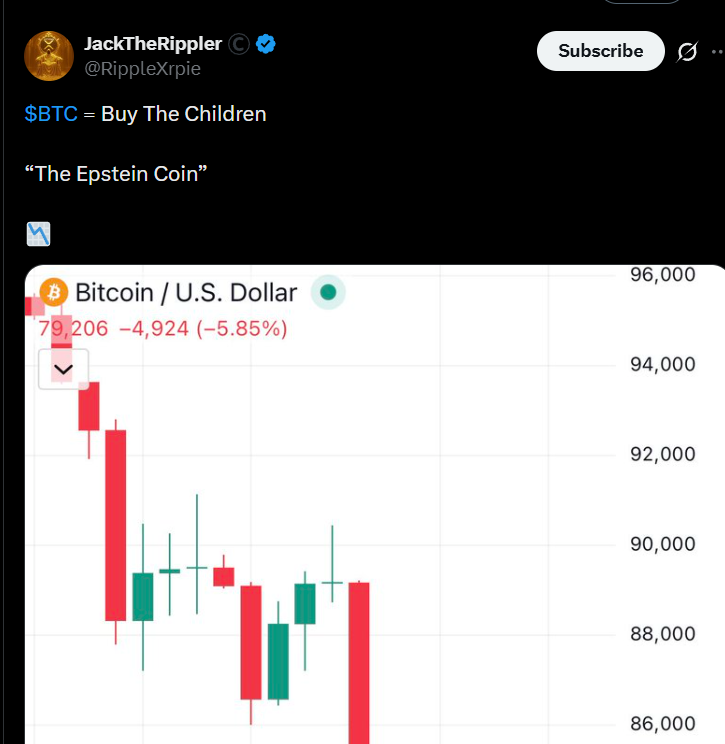
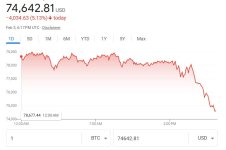
Look out below! BTC below $80K now ....
 

The quantum existential threat to crypto​

In Robert Harris’s The Second Sleep, the novelist imagines a world hundreds of years in the future where humanity has regressed to a mediaeval standard of living, population and way of thinking.

Towards the end of the book we learn what might have caused this calamity: not a pandemic, meteorite strike or nuclear war but a complete collapse in the digital economy.

From payment systems to just-in-time supply chains and the wealth of machinery that supports our lifestyles, the modern economy is almost wholly dependent on digital instruction.

If everything went down all at the same time, a state of anarchy would rapidly establish itself. In the ensuing chaos, it would be every man for himself with likely devastating consequences for lives and civilisation more widely.

Read the rest (c'mon, ya want to):

https://www.msn.com/en-us/news/tech...threat-to-crypto/ar-AA1VCY0G?ocid=socialshare
 

Bitcoin bleeds for second straight day, nearly grazes $72,000​

Bitcoin nearly touched the $72,000 mark on Wednesday, marking the second straight day of its massive retreat this week.

The world’s oldest cryptocurrency sank as low as $72,096.20, plunging more than 5% on the day. It was last trading at $72,958.38, down about 4% on the day. Bitcoin is currently more than 40% off its record high of about $126,000 hit last October.

More:

 
Well, this is the 4th year of the BTC cycle, the year it drops to a local minimum on 5 Oct. If you want BTC, maybe there is a flip to be had, buy in Sep, sell in the next cycle.
 
There may not be a next cycle. Unless the price of electricity crashes, BTC mining is not profitable at these prices and BTC mining companies are going to start folding or pivoting to other endeavors (like AI cloud services). At some point the BTC security model will be at serious risk. $.02
 
Bitcoin miners are bleeding cash as the network's hashrate has crashed 12% from its October high, and daily revenue briefly cratered to $28 million.

Bitcoin has slipped to roughly $70,000 on February 5 — about 20% below the estimated $87,000 cost to produce a single coin — as hashrate declines, shrinking margins, and a broader market rout drag miner profitability to its lowest point in 14 months.
...

More:
 
Yeah, it stands to reason based on math and physics that there is a limit to the number of those cycles, and if the cost per new coin is 87k and the price drops below that, new coin creation will die, so this might be the dip from which it never recovers. While I hold a token amount, I'm not a BTC fan, so consider my bias.
 
There may not be a next cycle. Unless the price of electricity crashes, BTC mining is not profitable at these prices and BTC mining companies are going to start folding or pivoting to other endeavors (like AI cloud services). At some point the BTC security model will be at serious risk. $.02

I really don't understand how low turnover endangers the security. It doesn't make encryption less hard to break.
 
Miners earn revenue from two sources - new BTC and transaction fees. The halvings cut the new BTC earnings in half every 4 years. Miner revenue is increasingly reliant on transaction fee revenue. That's a problem for a system with a low maximum transaction throughput. Additionally, the mining computation gets more complex/difficult with each block that is mined, so the effort gets more expensive (time & energy). Costs go up, revenue goes down.
 
PS opinion piece, dyodd.

 
Miners earn revenue from two sources - new BTC and transaction fees. The halvings cut the new BTC earnings in half every 4 years. Miner revenue is increasingly reliant on transaction fee revenue. That's a problem for a system with a low maximum transaction throughput. Additionally, the mining computation gets more complex/difficult with each block that is mined, so the effort gets more expensive (time & energy). Costs go up, revenue goes down.

Sure, so things slow down and it gets less usable. Understand that part, but how does that make it less secure.
 
Back
Top Bottom