Tin Foil Hats, Economic Reality and the Total Perspective Vortex

Welcome to the Precious Metals Bug Forums

Welcome to the PMBug forums - a community supported watering hole for folks interested in gold, silver, precious metals, sound money, investing, market and economic news, central bank monetary policies, politics and more.

Register a free account to join the discussions. When you register an account and log in, you may enjoy additional benefits including access to market data/charts and additional members only rooms (including one for trade/barter with the community).


Update

 
USA scores a political win in the fight for control of South American resources:
A Peruvian court ordered the government to oversee a Chinese-owned port near Lima, helping US efforts to curb Beijing’s growing power in the region.
...
The new ruling accepted the argument that, although Chancay is privately owned, it is a public-use port. As a result, it falls under Ositran’s powers to regulate, supervise, inspect and sanction operators under Peruvian law, the regulator said in a statement.

The decision can still be appealed. ...

 
Didn't know where to post this so I thought this was probably the best thread. Nothing to see, can listen in one tab, play around the forum in a different tab.

New Hong Kong GOLD System Changes Everything - 'This is a BIG DEAL': Eric Yeung

Jul 11, 2026 Commodity Culture
Eric Yeung breaks down major news in the gold market: Hong Kong has just launched a new gold clearing and settlement system that could change the entire game. With major banks like JP Morgan already signing on, Eric speculates that this development could push gold into more of a physical settlement market, as opposed to the paper market that dominates Western exchanges today.


33:14
 
Take it with a grain of salt.

Having listened to Eric's guest appearances on various podcasts...I'm less than impressed. He seems a tight roll of Talking Points, more than a true observer.

DYODD. I think he's a CCP plant to sell an idea, or many ideas, to the lower-strata listeners in the West.
 
Okay. This may not fit here; mods can move it about as they see fit.

But I found a little (180-minute) presentation, there on the Sump of Eww. It may have been linked on this board, or the other board, I didn't make a note. My habit is, when I see something, or get a YOU MAY LIKE and the title looks promising...I'll strip the audio and save it; and I get to it days, or weeks, later.

This is one of those.

The AI presentation - yup, it's AI all the way - focuses on the political theories of Villfredo Pareto - the author known for the 80:20 Principle. And some other concepts far more interesting. I admit I knew next to nothing of the man, other than the Principle.

He also had a few theories of the social and political structure of societies. The model used before him, was the Fox and the Lion. How the Elites in a society would take charge, or protect from threats, as would a lion; but must run a stable society as would a fox, with cleverness and subtlety.

Pareto's belief - defended well here (and now ignored in PoliSci classes) is that the Foxes and the Lions are two different types. The Lions use force, to impose order and to vanquish threats. Nothing clever or subtle. Through Elite Circulation, the Lions are slowly replaced by Foxes - the financiers; the diplomats; the unseen manipulators.

And when the crash or reorganization comes, it is always when Foxes are in control and cannot see the re-emergence of Elite Lions. Their answer is always basically the same - "That's just MADNESS."

The Lions come, and re-calibrate the social structure or build a new one, and, in 80 years or 250, the cycle repeats. The Lions do their work; the public wearies of brute force and comes to favor or accept the quiet subtlety of the Foxes. The Foxes come in, loot, create the Wealth Pump, and eventually create a situation they cannot find a way to gloss over, hide or correct.

Like I said, it's AI; and yes, it plods on. Try to deal with the fake Toff British accent; and don't bother with the CGI graphics. Listen to it. It displays...I won't say, "insight," AI's failing is it's incapable of insight...but it connects things in ways most people have not, yet.

It's basically a Black-Pill presentation, although the last eight minutes offers a hope of reversal. It sounds as false as the rest of it rings true.

I found it worthwhile. Put it on a flash drive and listen to it when in traffic, or going somewhere on the Interslab.

 
I listened to that the other day. May have to give it another listen as I don't think I finished it. I fall asleep (purposely, in bed) listening to podcasts, etc.
 
I asked Grok about the pending July 24 changes to China's SGE exchange for gold trading:

Grok said:
China’s Shanghai Gold Exchange (SGE) is shutting down personal (retail/individual) client trading operations for precious metals margin trading, with major banks ceasing related intermediary services after the end-of-day settlement on July 24, 2026.

This is not a full ban on gold trading or a direct change to SGE’s core rules for all participants. It specifically ends retail leveraged/paper trading access via banks for individuals.

Key Details of the Change​

Major Chinese banks, including the Industrial and Commercial Bank of China (ICBC—the world’s largest by assets), Postal Savings Bank of China, Ping An Bank, China Guangfa Bank, and others, announced they will stop acting as agents for personal precious metals margin trading on the SGE.

  • Effective date: After the clearing/settlement session on July 24, 2026. Trading permissions (via mobile banking, online banking, and branches) will be progressively shut down.
  • What traders must do: Retail clients with open positions should close them, liquidate, or take physical delivery before the deadline. After July 24, closing/selling/physical withdrawal options become restricted for remaining positions. Clients with no positions can have margin funds withdrawn in batches.
  • Affected products(examples from ICBC’s announcement):
    • Spot gold contracts: Au99.99, Au100g, Au99.95, PGC30g.
    • Deferred/delayed delivery contracts: Au(T+D), mAu(T+D), Ag(T+D), Au(T+N1), Au(T+N2).
Yes, similar changes apply to silver. The announcements explicitly cover precious metals trading, including silver via the Ag(T+D) contract. Some coverage refers to it as ending retail paper trading for both gold and silver.

Reasons Cited​

Banks and reports point to high volatility and instability in precious metals markets (gold prices had fallen sharply from peaks earlier in 2026), along with broader policy requirements to protect retail investors and reduce risks from leveraged derivatives. This follows earlier regulatory tightening on complex retail products.

What Is NOT Affected​

  • Physical gold and silver purchases.
  • Gold ETFs and accumulation plans.
  • SGE’s institutional and professional trading operations.
  • Physical delivery channels.
  • Central bank (PBoC) gold buying.
The move shifts emphasis toward physical ownership and away from leveraged retail speculation.

In short: SGE (via its member banks) is ending retail access to leveraged/paper precious metals trading on its platform after July 24, 2026. This applies to both gold and silver contracts for individual clients. Institutional and physical markets continue normally.

This information is based on bank announcements (e.g., ICBC on/around June 24, 2026) citing SGE’s decision, widely reported in financial media in the days leading up to the deadline. Always check official bank or SGE channels for the latest client-specific guidance.
 
Global de-dollarization efforts to accelerate just as China is reaching new milestones in bringing the RMB/Gold internationalization trade alternative to the dollar to life:

 
More from Eric Yeung about the July 24 market rule change in China:


...
What actually happened on/around July 24

Major Chinese banks (led by ICBC, the world’s largest by assets, along with Postal Savings Bank of China, Ping An, China Guangfa, and others) ended or severely restricted their intermediary/agency services that let retail/individual clients trade precious metals (gold and silver) on the Shanghai Gold Exchange (SGE). This covered both spot physical and deferred-delivery/T+D contracts (the latter involving leverage/margin). Clients were told to close, sell, or take physical delivery by the deadline; remaining access was disabled.
  • This was framed by the banks as risk management after a sharp multi-year rally in gold/silver reversed amid volatility.
  • It was not a blanket ban on gold ownership, physical bullion, gold accumulation plans, or ETFs. Those continued.
  • It was not a shutdown of all leverage or institutional activity on the SGE. Tier-1 members (the big banks themselves) remain. Speculative/retail-like activity (including from SMEs that used bank retail accounts for cost reasons) can migrate to the Shanghai Futures Exchange (SHFE) for futures or potentially to the developing Hong Kong market for forwards/OTC.
Eric’s clarification that “retail” on the SGE often includes small/medium enterprises (not just ordinary individuals) and that the move is more about channeling activity than eliminating it is accurate based on how the SGE membership and bank-agency structure works.

Hong Kong side and the longer-term picture

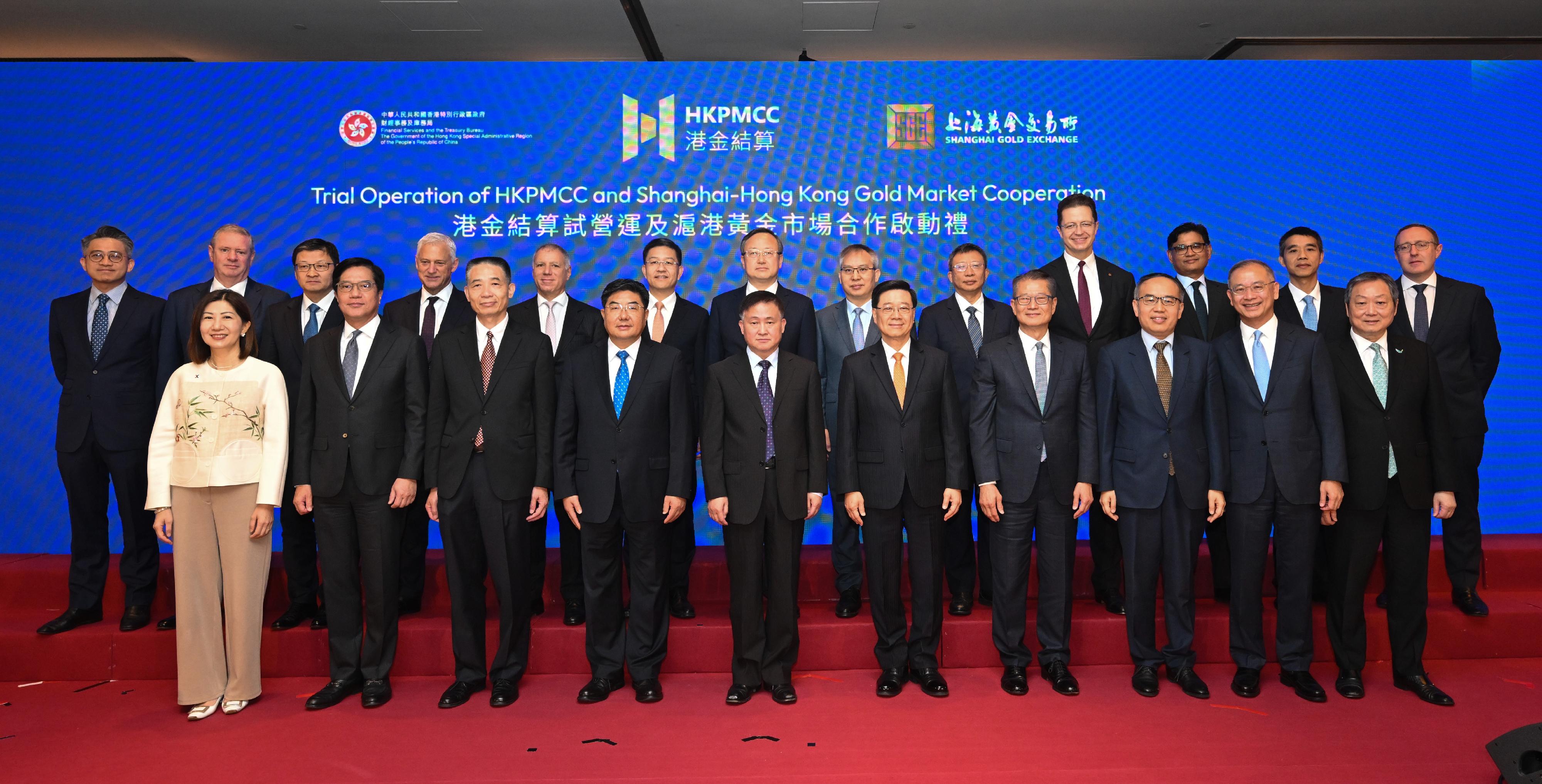
Hong Kong’s Precious Metals Central Clearing Company (HKPMCC, government-backed) began trial operations of its central gold clearing and settlement system in early July 2026 (around July 7). It supports OTC/bilateral trades, unallocated gold (typically 400 oz London Good Delivery-style bars), vaulting, and a “Delivery Connect” physical two-way link with the SGE. Multiple major banks (HSBC, JPMorgan, Bank of China (Hong Kong), ICBC Asia, etc.) are participants. The explicit goal is to build Hong Kong into a major international gold trading, clearing, and storage hub, with plans to expand vault capacity significantly.

Eric is right that this is modeled in the LBMA/OTC style (unallocated positions, forwards, etc.) and benefits from Hong Kong’s lack of mainland-style capital controls—addressing the limited foreign uptake of earlier efforts like the SGE International Board in the Shanghai Free Trade Zone. The interpretation that this fits a longer Chinese strategy of elevating physical gold as high-quality collateral/settlement asset for trade (especially with BRICS/Global South partners), rather than relying primarily on US Treasuries, is a coherent reading of the infrastructure build-out, China’s gold accumulation, RMB internationalization efforts, and public statements about Hong Kong’s commodity-hub ambitions. It is not presented as an overnight “repricing” switch.

Bottom line

The factual description of the SGE bank-retail changes, the distinction from a total leverage ban, the shift possibilities to SHFE/Hong Kong, and the existence and purpose of the HKPMCC system all check out against contemporaneous reporting. The “bigger than repricing / physical gold as collateral infrastructure” framing is interpretive strategy analysis, but it is grounded in the observable policy steps and consistent with Eric’s prior commentary on these topics.

Speculative claims circulating on social media that overstated the July 24 event as an immediate market-shock or total shutdown were the ones that needed correction—and Eric provided that correction accurately.
 
🚨 Scott Bessent just pointed toward a Bretton Woods 2.0 and is telling people to get ready for it.

He said: “The banking system created after WWII unleashed global prosperity. Why not recreate it now?”

He’s openly talking about “rewiring the banking and financial system.”
...


Screenshot says China's competing bond offers "significantly lower yields", but it might be something worth watching.
 
I had been wanting to make a timeline chart of the events captured in this thread, but have not as yet gotten around to it. Here's someone else's work for posterity:

 
China is building a global network of gold vaults and accelerating central bank reserve buying as part of efforts to promote the yuan’s role in international trade, according to an S&P Global Ratings report on Tuesday.

Firms such as Zijin Mining – China’s largest gold processor – and Shandong Gold Mining were also expected to expand “faster than most of their global peers” after Beijing reclassified gold from a financial asset to a “strategic mineral” in 2025, the report said.

“If you are trading in renminbi, there’s always a question as to how you are going to use the renminbi,” said Charles Chang, greater China lead for corporate ratings at S&P Global. “But if that renminbi is convertible to gold, then that’s a potentially different picture. Gold is tradeable. It is usable in a lot of places.”
The country’s first offshore gold delivery vault was launched in Hong Kong last year under an agreement with the Shanghai Gold Exchange (SGE), with Bank of China (Hong Kong) as the designated operator.

Alongside the launch, the SGE listed two new yuan-denominated gold contracts, which can be settled through either physical delivery or cash transfer.

Other cities under consideration for China’s vault network included gold trading hubs such as Singapore, Kuala Lumpur, Dubai, Riyadh and Moscow, the report said.

“The network offers connectivity to the world’s largest physical gold market,” Chang said. “It could also attract countries looking to diversify, onshore or nearshore their gold storage to enhance control.”

 
Yes, China is looking to step in once the dollar goes the way of all previous fake, overprinted fiat.

There is a problem, however. THAT the Chin need to demonstrate their currency is tightly linked to gold, shows a basic lack of trust.

And trust is essential to a World Reserve Currency. Consider Britain: While brutal in some aspects, Britain and its predecessors pioneered the implementation of Rule of Law - that all were held to the same codified standards, even kings (as several beheaded royals could attest to).

China, since Mao, has been a brutal, repressive police state. To this day, even, with Social Credit Scores and the eagerness in which they cosplayed the Virus Fraud. The world SIMPLY DOES NOT TRUST them. Despite all the (paid, most-likely) "Influencers" babbling on about how "great" are those cheap battery cars out of China, anyone who's ever owned a Chinese motorcycle...or refrigerator...or other appliance (excluding computers, which actually are built well) knows how deliberately shoddy is their "merchandise" (crap).

Computers as the exception, IMHO, is because personal computers are an offshoot of surveillance technologies - something they are REALLY INTO. The Police-State mentality. They cosplay Free Enterprise, but what they have, is what the West calls "State Capitalism."

Benito Mussolini called it Fascism; and demonstrated how it always unfolds - no matter what Western shills are paid to advertise it as.

And a Fascist police state is not going to have trust or credibility as provider of the World's Reserve Currency. Which is also why WE are losing our status there - as we are not only broke and bankrupt, but are also spiraling into some sort of social collapse and anarcho-tyranny.
 
Hence the need to maintain vaults/warehouses in foreign jurisdictions.


US targets UAE bank in first effort to make good on Bessent's threat. Any short term benefits of this strategy will be Pyrrhic victories as the world gets further galvanized against the weaponized dollar based financial system.
 
Russian gold floods through Hong Kong in wake of western sanctions

Russian gold shipments to Hong Kong have surged this year as the Chinese territory becomes a top trading centre for bullion placed under sanctions by the west.

The shift comes at a time when Asian hubs are vying to control more of the global gold trade that has traditionally centred on London, New York and Dubai.

Hong Kong trade data shows that almost 100 tonnes of gold were imported from Russia during the first seven months of this year, a record level and nearly three times the amount imported during the same period in 2025.

“Since London closed its doors to Russian gold following the outbreak of the Ukraine conflict, Russian producers have increasingly redirected exports to eastern markets,” said Debajit Saha, analyst at the London Stock Exchange Group.
...
Because mainland China imposes quotas on gold imports, Chinese buyers frequently purchase bullion and hold it in Hong Kong, which has no restrictions on imports, said LSEG’s Saha.
...
The Middle East conflict is further enhancing Hong Kong’s role as a clearing centre for gold from Russia, in part due to logistics disruptions in Dubai.
...
However, analysts cautioned that the rising volumes of Russian gold in Hong Kong present a challenge for the city’s international financial industry, because they make it more complex for western banks and refineries to comply with overseas sanctions law.
...

More:
https://www.ft.com/content/39b0c966-b153-4706-9325-2f6176ba3752?syn-25a6b1a6=1

The last quoted paragraph is the FT's warning to Western banks.
 
President Donald Trump declined a request for military support from Crown Prince Mohammed bin Salman of Saudi Arabia on Thursday, a U.S. official told Axios on the condition of anonymity, as analysts warn that the U.S. war against Iran is starting to spiral out of control.
...

https://www.msn.com/en-in/news/othe...r-help-as-iran-war-spirals-report/ar-AA2c1vQc

Petrodollar implications if true. Axios is rather loose with facts/truth, so this could easily just be some propaganda to achieve some unclear Trump admin agenda.
 
...
Project mBridge was developed through collaboration involving the BIS Innovation Hub, the Hong Kong Monetary Authority, the Bank of Thailand, the Digital Currency Institute of the People’s Bank of China and the Central Bank of the UAE, with Saudi Arabia joining as a full participant.

Its objective was to explore a multi-CBDC platform where participating central banks and commercial banks could conduct cross-border payments and settlement using central bank digital currencies.
...
BRICS Pay is a broader concept associated with the BRICS Business Council and the wider BRICS Cross-Border Payments Initiative.

Its focus is more on connecting national and commercial payment systems, supporting cross-border transactions and enabling greater use of national currencies.
...
So, in simplified terms:

mBridge → shared multi-CBDC settlement infrastructure

BRICS Pay → interoperability and payment ecosystem approach
...

 
Any time the Bank of International Settlements, an above-the-law supergovernmental organization...any time, any place, they're involved, such an operation or protocol is suspect.
 
German Bundestag publicly opens Pandora's Box.

All other Central Banks will be considering the same.

The music has stopped - please be seated.

====================

The Bundestag resolves:

I. The German Bundestag notes:
With holdings of 3,350 tonnes, Germany possesses a very large reserve of state-owned gold by international standards. The book value of this stockpile has been rising for decades and has actually doubled in just the two years since the beginning of 2024, reaching approximately 460 billion euros! The revaluation gain on Germany’s gold alone, as recorded on the Bundesbank’s balance sheet, amounts to more than 150 times our central bank’s equity capital.

Thus, despite the official absence of a gold backing for the former Deutsche Mark and the current euro, gold remains—in practice—a vital psychological and material guarantor of our currency’s stability. The only substantial item on the asset side of the Bundesbank’s balance sheet that carries no counterparty risk is precisely that of the gold reserves (Assets A.1: Gold and gold receivables).

Following a successful citizens' initiative and the repatriation of significant portions of Germany’s gold held abroad starting in 2013, approximately 51% of Germany’s state-owned gold is currently stored within Germany. However, 49% still remains abroad—specifically in New York with the Federal Reserve (Fed, 37%) and in London with the Bank of England.(BoE, 12%). The tonnage still stored abroad is now worth approximately 225 billion euros—twice the value of Germany’s total holdings in 2013.

Storing gold in the USA and Great Britain starting in 1951 was advantageous during the 1950s and 1960s under the historic Bretton Woods global monetary system; gold generated primarily from German trade surpluses with Anglo-Saxon nations was credited to Germany—or, in technical accounting terms, to the Deutsche Bundesbank—in New York and London at the then-fixed rate of 35 dollars per ounce. However, the Bretton Woods system has not existed for many decades; it ended in 1971/1973.

For centuries—and continuing after 1971—gold has been a fundamental component of the sovereign standing of major nations. It is free from counterparty default risk, cannot be arbitrarily inflated or devalued by political decree, and is becoming increasingly significant as an official form of currency—a status recently confirmed by the Basel III accord through its designation as a Tier 1 reserve asset.4 Gold offsets the devaluation risks associated with massive global debt and inflationary trends; global debt has skyrocketed to 346 trillion dollars as of 2025.5

Internationally, gold is widely regarded as a strategic hedging instrument for protection against currency and systemic risks—particularly during turbulent times marked by rampant sovereign debt and, as is currently the case, often accompanied by geopolitical crises.

Consequently, nearly one in two nations—or rather their central banks—is currently increasing its physical gold reserves, as are a growing number of institutional and private investors. In the precious metals markets, the "paper markets" (derivatives such as futures, certificates, options, ETFs, and ETCs) are in some cases a hundred times larger than the physical exchanges and storage facilities. An increasing number of central banks, as well as private and industrial buyers, perceive a significant risk that they will be unable to secure delivery of their physical gold and silver holdings—specifically those that are not clearly verified and documented as "allocated" and "audited"—during future (or even current) supply shortages, despite holding legal title to the assets. For both private and professional investors, physical possession of precious metals within their own sphere of control is becoming increasingly important compared to a mere legal claim of ownership.

Some nations are now preparing—for the first time since 1971—the option of adopting (partially) gold-backed currencies or an international monetary system based on gold. Germany, too, must establish and consistently maintain this option—a requirement that necessitates the storage of the nation's gold reserves entirely within domestic German vaults.

The Deutsche Bundesbank, too, fundamentally recognizes the strategic importance of gold—indeed, even the ECB’s balance sheet was physically "capitalized with gold" (to the tune of several hundred tons of the precious metal) for good reason upon the introduction of the euro on January 1, 1999.

A country’s "golden currency and sovereignty reserve" should, in principle, be held within the owner country itself, free from storage risks. Consequently, keeping German state gold abroad has long been unjustifiable; it represents a strategic and monetary-policy risk that could easily be avoided. As the owners of the gold assets managed by the Bundesbank merely in a fiduciary capacity, the citizens of this country have a right to expect that their national wealth be located entirely on German soil and under German jurisdiction, free from third-party risk.

The Deutsche Bundesbank’s perennial counter-argument—used to reject the full repatriation of German state gold, a move long overdue—always boils down to the same point, however phrased:
"In the event of a global financial and currency crisis, the gold could be directly exchanged for foreign currencies [such as the dollar or pound]. [...] We need to be able to use it in a crisis—that is, to exchange the German gold directly from its foreign storage location for foreign currency and paper money."

This line of reasoning—repeatedly advanced by the Bundesbank since 2013—ignores both the fundamental nature of sound money (paper banknotes originated as gold deposit receipts) and the lessons drawn from numerous historical monetary crises. Is the Bundesbank really insisting on keeping its gold abroad precisely during a global crisis marked by "extreme turbulence in foreign exchange markets"? Does it intend to exchange the only asset class free from third-party risk—a risk that becomes existentially dangerous during financial crises—for mere claims on gold stored elsewhere? In other words, it seeks to trade for the very types of warehouse receipts and risky paper assets that every other party tries to offload during global currency turmoil.

Given the historic upheavals and breaches of trust within today’s international regulatory framework, no one can understand why a central bank—committed solely to German interests and its citizens—would want to swap gold (the ultimate currency) for "paper" claims that are highly vulnerable precisely during times of crisis. Recent developments confirm this trend: states, central banks, and both institutional and private investors are demanding physical delivery of metals with increasing frequency—often on a daily basis—demonstrating a powerful drive toward precious metals that are physically accessible domestically, rather than derivatives stored insecurely abroad.

Consequently, the Bundesbank’s long-standing argument is no longer tenable; indeed, it is ahistorical, irrational, and downright absurd. Moreover, should there ever be a serious need to sell German state-owned gold during a crisis, it can be traded without difficulty on the leading German exchange in Frankfurt am Main. In any case, historical accidents—such as the trading hubs in New York or London—do not justify the permanent storage of gold at those locations; indeed, an increasingly large share of professional physical gold trading is currently shifting away from them, particularly toward the Shanghai Gold Exchange. Following the LBMA (London), the CME/Comex (Chicago/New York) is now also on the verge of losing its status as the dominant market for setting gold prices.

In times of crisis or tension, physical access to gold stored abroad can be blocked—for instance, by sanctions. Experience from recent years and the present day shows that, in many cases, the unrestricted availability of one's own reserves can only be guaranteed domestically. Even regarding states, central banks, and other institutions overseas—and within the EU—that were previously considered legally secure or friendly, doubts are increasingly arising about the unrestricted ability to dispose of state assets held abroad: the EU recently sought to confiscate foreign state assets, and the US Trump administration has also confiscated assets belonging to third countries. International debates regarding the storage of gold abroad—specifically at the New York and London depositories—have been ongoing for years, and dozens of nations have repatriated their gold holdings since around 2013. To this day, the Fed and the BoE regularly face repatriation requests from an increasing number of countries holding gold in New York and London.

Germany’s state gold holdings at the Fed and the BoE alone are now valued at 225 billion euros. The US could, at any moment, raise a claim—whether real or fabricated—for this amount: for example, should the German government fall into arrears on payments for US arms shipments to Ukraine, the US could well demand, and enforce, a form of "offsetting" against German gold. From the US perspective, it would be "convenient" that the funds owed by Germany were already sitting in New York, ready to be withheld. What would have been unthinkable for decades is no longer so in an era where certainties regarding international and financial law are rapidly eroding. The security-policy and institutional landscape is currently undergoing extremely rapid change.

Even the ECB itself is currently engaged in a consequential dispute with the Italian government and the Banca d’Italia regarding the ownership of Italy’s state gold reserves—a matter of great relevance to Germany and the Deutsche Bundesbank as well, particularly given the critical importance—especially in times of crisis—of questions concerning the ownership, possession, and storage of national gold holdings.

The repatriation of our Bundesbank gold is therefore an essential and long-overdue first step toward dispelling all doubts regarding ownership and the unencumbered, immediate availability of the gold, thereby ensuring Germany’s sovereign capacity to act regarding its citizens' assets.

II. The German Bundestag calls upon the Federal Government to:
1. develop, jointly with the Deutsche Bundesbank, a binding schedule for the repatriation of all German gold reserves held abroad and to implement it promptly—specifically, the approximately 1,236 tonnes currently held at the Fed in New York and the 404 tonnes at the BoE (London);
2. ensure that, in the future, gold reserves are stored exclusively within the Federal Republic of Germany, in order to preserve the option for Germany of (partial) gold backing for a currency that might potentially revert to a national currency in a post-euro scenario;
3. submit an annual report from the Deutsche Bundesbank to the German Bundestag detailing the holdings, storage locations, full bar serial numbers and fine weights, any transactions or lending activities, and the valuation trends of the German gold reserves;
4. speak out emphatically at the EU level against any inclusion of national gold reserves in European liability or pooling mechanisms;
5. agree with the Bundesbank to inform the German public transparently about the volume, location, and security of the gold reserves in order to strengthen confidence in the stability of German monetary policy;
6. work towards a legally binding and permanent clarification of the ownership status of German gold vis-à-vis the ECB, distinguishing between the main German holdings accumulated since 1951/1967 (currently approx. 3,350 tonnes) and the tonnage provisionally transferred to the ECB in 1999 for its initial gold capitalization;
7. establish a special balance-sheet status—safeguarded under constitutional law—for the "citizens' gold" held in trust on the Bundesbank’s balance sheet.

Berlin, 17 March 2026
Dr. Alice Weidel, Tino Chrupalla, and the Parliamentary Group

Rationale
Gold represents materialized labor and guarantees the individual freedom and a certain degree of independence. The same applies to state-owned gold: Germany’s gold reserves also represent tangible assets derived from the economic successes achieved in foreign trade by the young Federal Republic during the 1950s and 1960s. Rightly, this state-owned gold secures a measure of sovereignty for the country's working citizens. The Bundesbank manages these gold assets in trust for the German state and the German people.

The Bundesbank does not subject its foreign gold holdings to regular, comprehensive physical audits; in fact, there have never been full audits at the foreign storage sites since 1951 (when Germany began storing gold abroad). The Bundesbank relies on inventory data provided from abroad and on minimal spot checks of its own. There are no transparent, fully published lists of the Bundesbank’s gold bar numbers. While "bar lists" do exist, "inventory numbers" are not a substitute for bar numbers, nor are "melt numbers"; publishing abbreviated numbers violates standard accounting principles; there is no known or published evidence linking specific individual bars to the Bundesbank’s balance sheet; and full physical audits are not conducted. Consequently, the possibility of double or multiple counting of bars (or bar numbers) in the balance sheets of other central banks or gold ETFs cannot be ruled out—yet only such verification could conclusively prove Germany’s exclusive claim of ownership.

The Bundesbank repeatedly emphasizes its full confidence in the Fed and the BoE, asserting that the remaining German state gold is safely stored in New York and London. However, trust is not an audit strategy. In times of crisis or heightened tension (potentially even involving current allies or friends), the rule is that only those who physically hold their gold truly control their property. During periods of geopolitical tension, property rights are not guaranteed without actual possession. As early as 2012, bodies such as the Federal Court of Auditors raised concerns regarding the Bundesbank’s inadequate auditing practices; yet, little has changed in that regard.

The justification that this constitutes "storage based on trust with partner nations" is unconvincing from economic, legal, and insurance perspectives alike. Trust is no substitute for sovereignty. Gold is not merely an investment asset but a strategic anchor of value. Its physical availability within the country is a prerequisite for ensuring our nation remains capable of acting in times of financial instability, international tension, or systemic crisis.


 
Back
Top Bottom