
You are using an out of date browser. It may not display this or other websites correctly.
You should upgrade or use an alternative browser.
You should upgrade or use an alternative browser.
Weird Stuff on YouTube
- Thread starter nickndfl
- Start date
Welcome to the Precious Metals Bug Forums
Welcome to the PMBug forums - a community supported watering hole for folks interested in gold, silver, precious metals, sound money, investing, market and economic news, central bank monetary policies, politics and more.
Register a free account to join the discussions. When you register an account and log in, you may enjoy additional benefits including access to market data/charts and additional members only rooms (including one for trade/barter with the community).

I kinda remember that area, from my short time in the Keys over New Year 2014.
I remember the city sign, Marathon - both because I've lived near Marathon, Wisconsin, and because Marathon Petroleum (Findlay, Ohio) had a big presence in the Cleveland area.
I was camping on Big Pine Key. I'd go and do all the walk-about things at Key West...excepting the bar runs; even then I was too old for that.
It was a good time, especially the group at the RV park I met (I only had a tent, but they let me set up). New Year's Eve on the beech, and they did share some whiskey with a stranger...me.
What really hit me even then, though, was the cost of living there. The rent. Even then.
I remember the city sign, Marathon - both because I've lived near Marathon, Wisconsin, and because Marathon Petroleum (Findlay, Ohio) had a big presence in the Cleveland area.
I was camping on Big Pine Key. I'd go and do all the walk-about things at Key West...excepting the bar runs; even then I was too old for that.
It was a good time, especially the group at the RV park I met (I only had a tent, but they let me set up). New Year's Eve on the beech, and they did share some whiskey with a stranger...me.
What really hit me even then, though, was the cost of living there. The rent. Even then.


Too hot to camp now. Everything is expensive, but if I lived in Marathon I would have a small home on stilts with a dock and a 21' Mako.I would eat.lots.of fresh catch and watch YouTube.
Not much to do other than watersports or flying small aircraft. The city.of Key West is a tourist trap of the worst kind. I work there every month, but am turning that gig over to my step son shortly. I seen it and done it all in FL.
Not much to do other than watersports or flying small aircraft. The city.of Key West is a tourist trap of the worst kind. I work there every month, but am turning that gig over to my step son shortly. I seen it and done it all in FL.


This poor little guy almost got crushed to death.
Kinda reminds me of an accident we had at a job site one time where a guy got his head stuck in between the table and edge of the frame of a cnc drilling machine.
Kinda reminds me of an accident we had at a job site one time where a guy got his head stuck in between the table and edge of the frame of a cnc drilling machine.
A blast from the past!
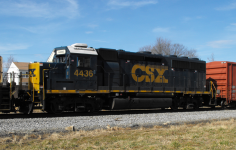
I'd almost bet I'd run that unit...it's a former Conrail GP-38, looks like. Conrail was an early adopter of "anti-climb" pilots...castings above the couplers, incorporated into the frame, that would catch a coupler from another engine or a railcar from working up above the loco's coupler and then shoving into the carbody. Now it's standard, probably required; but in the 1980s, only Conrail ordered power. Former SBD or Chessie EMDs of that era, just had the walkway end abruptly, with a narrow drop-down foot walkway extender out of sheet metal that was to meet one from another unit, when coupled together. The anti-climb pilots almost met, when one engine was tied to another.
Second...traction control was a new thing on those units. I had one one night, we were working an industry turn...I had an SD-40 as lead power, with a GP-15 as a trailer. The GP-15 was adapted from the MP-15 yard model...the GP was intended to replace the 1950s-vintage GP-7 or GP-9. They didn't get many customers - railroads decided to order MP-15s for yard and transfer work. But Conrail had a few, because they had a lot of secondary lines that would later be ripped out. Light axle-loading ratings.
But there was an obscure (and unmarked) circuit on its panel that kept tripping all night, and taking the main power with it. Finally I figured out that the main breaker would stay on if I left that one circuit off...that, until we were yanking a heavy drag of cars out of an industry, and my man on the ground was yelling at me to stop. Turns out that the 15 was spinning its axles like grinding wheels.
CSX's contribution to this, once they took control of our part of Conrail...was, they didn't believe in giving the crews enough. Of anything. Not enough time to get a job done; not enough pay to motivate the crews (there were ways to chisel pay, since we were paid by the job, not the hour) and not enough power. EVER. Not on the road, not on industry or yard works. Our joke was, the multi-levels (auto racks) were 60-mph trains with 30-mph power. That was if you ran at Notch 8 the whole way. The koledge kidz in Jacksonville, who would have to authorize usage of power ON EACH TRAIN (the Power Desk, they called it) said, the rulebook said it was enough.
Yeah, when new. These were 25-years-old and moar; and often maintained to Seaboard or ACL standards (two slipshod predecessors of CSX). So, trains that could get Cleveland to Buffalo in five hours, now took over twelve.
And of course 12 hours was our on-duty limit, by FRA standards. And we were paid no overtime.
So...often in yard moves, one GP-38 or SD-40, pulling cars like that, would wind up lighting off the rails as traction would break free. Looks snowy out there; that can promote wheel slippage.
The fire out the stack, comes from hundreds of hours of idling, where oily soot cakes onto the stack, followed by a protracted burst of really-hot exhaust, as in pulling very hard for maybe 30 minutes. It's not dangerous - not to the engine. Engine fires come from fuel leaks or electrical shorts. What those stack fires can do, is start wildfires in dry areas. Sparks and even oily clumps blow out, on fire, and start tinder burning.
EDIT: I got curious. So, I looked up the number - yeah, you can do such things, foamers (rail freaks) have a big presence online - and I was half-right. It is a former Conrail unit - CSXT 4436 was renumbered from CR 3363.
But it's not a GP-38. It's a GP-40-2, a locomotive that wasn't common in Cleveland or Buffalo. I only ran a few of them, time to time.
Online photos, as CSX 4436, were taken at Wallbridge, Ohio, outside Toledo. The Dash-2 models had modular electronics, a big step forward for their time. I couldn't find a build date, but probably it was about 1979-84. Conrail was on a buying spree, being newly profitable, and no one knew the future would be with six-axle (SD-series, for EMD) locomotives, not the four-axle (GP or F series) that brought in the diesel revolution in the 1950s.
Portrait photo of it, in better condition, with new-ish "Dark Future" (third pain scheme for CSX corporate) paint, here:
Apparently the unit was having a turbocharger failure when that video was snapped. Probably the engineer was trying to keep things moving, and gave it too much throttle.
Last edited:
^^^
Weird.
That was what Eww Tube was in its early days - insane, vulgar, often mindless.
I expect that one will be pulled soon.
Weird.
That was what Eww Tube was in its early days - insane, vulgar, often mindless.
I expect that one will be pulled soon.

- Messages
- 47,447
- Reaction score
- 7,883
- Points
- 288
I expect that one will be pulled soon.
Nah..............he's a real star. Whole lotta fans.

Vic DiBitetto - Wikipedia

Vic Dibitetto
Tired of the unfunny, no-talents on TV? Then click on this link to see thousands of the funniest videos you'll ever see! Vic is managed by Best Entertainment Group http://www.bestentgroup.com info@bestentgroup.com
 www.youtube.com

Viking
Yellow Jacket
Aircraft windshields can't be "shattered" like a car. But A for effort, lol.
Yea, but you'd have to at least try even if ya knew there was no way you could break it.Aircraft windshields can't be "shattered" like a car. But A for effort, lol.
Although I did see a guy one time who busted 3 big pieces of 3/8th thick laminated safety glass.
With his head.

F'er acted as though it didn't even faze him.
So ya never know, hit something just right and ya might get lucky.
Viking
Yellow Jacket
It was Texas, coming from Mexico. NetJets.Haven't they ever heard of an airport?
Investigators seek clues in small jet crash that killed 1 in Texas, where bystanders rushed to help
Investigators are on the scene where business jet crashed on a Texas highway, killing one person on board.
 apnews.com
https://abcnews.com/US/1-dead-after-private-plane-crashes-texas-road/story?id=133952314
Last edited:
They weren't thinking. They were panicking.Aircraft windshields can't be "shattered" like a car. But A for effort, lol.
It happens.
They were doing the only thing they could do at the time. What other potential way in was there?They weren't thinking. They were panicking.
It happens.
Even if there were some sort of handle on the door, how you gonna get up there to try opening it? Never mind the flames being right there.
.....and I think it might have to be opened from the inside anyways?
There are people trapped and about to be burned alive.
Ya got a choice.
Try to take a chance of breaking the window, or stand there explaining to everyone about how futile it would be to even try to break it.
Which action plays better on video on the 6o'clock news?
Which guy would you want to be seen as?
The one giving a valiant effort trying to save lives in face of clear danger? Or the guy who just stood there explaining the physics of the situation without even trying?
Gotta at least try. People's lives were on the line.
Viking
Yellow Jacket
Bear spray, gun?
Bueller
Bueller
Video pulled.
Ewww Toob is NOT gonna allow any videos showing life as it is, as nature intended. Not male with female; not people discussing issues of import. Not drunks or NO NAME GIVEN truck-drivers, crashing.
Ewww Toob is NOT gonna allow any videos showing life as it is, as nature intended. Not male with female; not people discussing issues of import. Not drunks or NO NAME GIVEN truck-drivers, crashing.
I started watching this...got as far as where Sagan started bemoaning...ALL THE WHITE PEOPLE in (the ENTERTAINMENT movie) Star Wars.
I have no patience for Woke - I got filled to capacity back in the day, and now I just throw it back. Star Wars wasn't instruction and it wasn't history - it was entertainment, for white people. Black people were in the phase back then, when they'd stand on their heads and spin like a Roto-Router, and call it "dancing." Dance-breaking, or some such idiocy.
Woketardedness is how we got to this dystopian purgatory we're in; and Sagan was, then, ready to spread it. I'm sorry he hates that he's white. I'm sorry he and "great minds" had to poison the well of intellectualism, with his psychoses.